In the fall of 1919, Bertha Benson and her younger brother John, two American-born children in Sweden, hid aboard a freighter in the harbor of Gothenburg. When they reached Ellis Island in December, their story was picked up by the newspapers in New York and Boston. These two articles tell it in the words of the time.
The Evening World, December 19, 1919
The New York Evening World ran the story on page 7 the day after the children reached Ellis Island, with a photograph of the two of them.
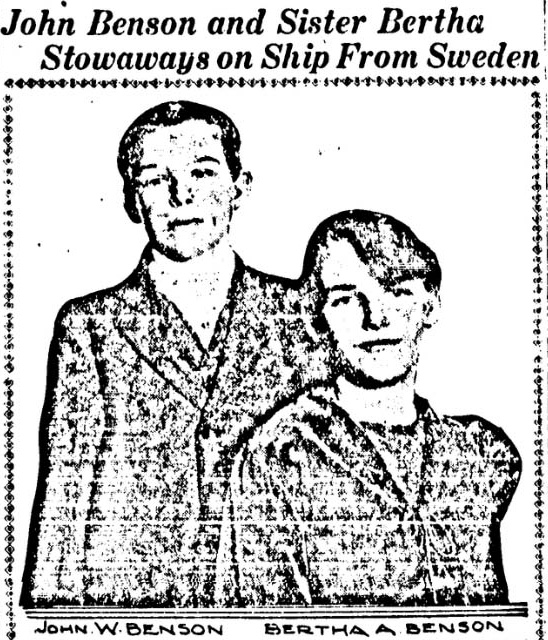

U.S. TRIES TO SEND TINY STOWAWAYS TO OLD HOME HERE
They Reach New York From Sweden, Where Their Mother Is Now Insane.Getting to Worcester, Mass., via Ellis Island is a roundabout route, but two young stowaways on the Island are so insistent on reaching that city that the authorities have made every effort to facilitate their purpose.
They are John Benson, 13 years old, and his sister Bertha, 15. Their father, Peter Benson, a painter, died in Worcester four years ago. The struggle proved too much for their mother, Mrs. Selma Benson, and she sailed several months ago for Sweden with them to make their home with relatives.
They failed to find these relatives. The mother went to work, but earned little. Worry drove her insane.
Having no funds with which to return to America, the children clambered, the night of Oct. 23, aboard the freighter Shortsville of the France and Canada Line, which had put in at Gothenburg.
They hid in the engine room and spent the night there. But they lost no time in coming to the deck when the breakfast gong rang.
In duty bound, the ship's officers reported the stowaways Dec. 1, when the vessel tied up at Hull, England. To the delight of the youngsters, the authorities there decided that because they did not have passports they could not land.
“To the delight of the youngsters”: if the English authorities had let them land, the children would have been sent back to Sweden from England. Because they could not land, they stayed aboard and came on to America.
The Boston Post, January 4, 1920
Two weeks later the children were still at Ellis Island. The Boston Post reported that they would be allowed to stay only if Worcester could prove they had been born there. The reporter heard Bertha's own account of the voyage.

HOLD TWO CHILDREN AS ALIENS
Stowaways from Sweden Must Prove U.S. BirthNEW YORK, Jan. 3—If the officials of Worcester, Mass., can find records of the birth there of Bertha Benson, aged 15, and of her brother, John, two years younger, the two children stowaways from Sweden will be permitted to leave Ellis Island. Otherwise their protestations that they are Americans by birth will be disregarded and they will be sent back to Gothenburg.
CAPTAIN A KINDLY MAN
Bertha, the youngest of a number of the girls who have crossed to America as stowaways since the ending of the war, hid with her brother in the engine-room of the cargo carrier Shoteville of the France Canadian line the night before the ship left the harbor of Gothenburg. John had been working in the shipyards there and learned from fellow-workers the time the ship was to sail. They were found when the Shoteville was nine hours at sea.
The girl was taken before Captain Otis W. Clark, and she told him that her father, a painter, was killed by a fall at Worcester in 1915, and that her mother had taken them to her native place in Sweden the year after. Two years ago, she said, the mother became insane, leaving the two children to shift for themselves. After a brief period of wandering they reached Gothenburg, where the boy went to work, while his sister kept house.
“I was very much frightened, and ashamed of my grimy face and clothes,” said Bertha, describing her meeting with the captain. “But he laughed and told me not to mind, and when we touched an English port he bought me these clothes.”
Bertha indicated a bright blue smock, a plaid skirt, and spats, quite evidently the choice of a man out shopping unassisted.
“The captain put John to work in the galley,” she continued, “but I ate with the ship's officers and had the captain's own cabin.”
What Happened Next
Both children had been born in Worcester, and their birth records survive. They were allowed to stay: Bertha lived in the United States for the rest of her life, and John was living in Springfield, Massachusetts, in 1951. The uncle they had hoped to live with in Rhode Island, their father's brother Carl, known in Rhode Island as Charles Ernest Benson, had died on June 18, 1919. The Providence newspapers followed the story from day to day, until Swedish families in Rhode Island offered the children homes: John with John Olson of Providence, and Bertha with her cousin Hjalmar Janson in Cranston. That part of the story, with eight more newspaper articles, is on Little Stowaways. Years later she and John found each other again, when John turned out to be the milkman driving past her house. Her story is told on her own page.
The two newspapers disagree
The two articles tell the same story but differ in several details, and neither reporter had any way to check what the children said.
- Their ages. Both papers make Bertha 15 and John 13. Bertha was born on June 25, 1905, and John on July 12, 1907, according to their Worcester birth records, so they were 14 and 12.
- Their father's name. The Evening World calls him Peter Benson. Bertha's death certificate and obituary call him John Benson. Both are right: his full name was John Peter Benson.
- When they went to Sweden. The Evening World says their mother sailed “several months ago.” The Boston Post says she took them to Sweden the year after their father's death in 1915. His death certificate confirms that he died on February 26, 1915. Family information is that they came back to the United States in the summer of 1917 and early in 1919, and went back to Sweden each time; their passport photograph was taken on January 30, 1919.
- When they were found. The Evening World says they came up on deck when the breakfast gong rang; the Post says they were found when the ship was nine hours at sea.
- The ship. The Evening World names the freighter the Shortsville, of the France and Canada Line. The Post spells it Shoteville.