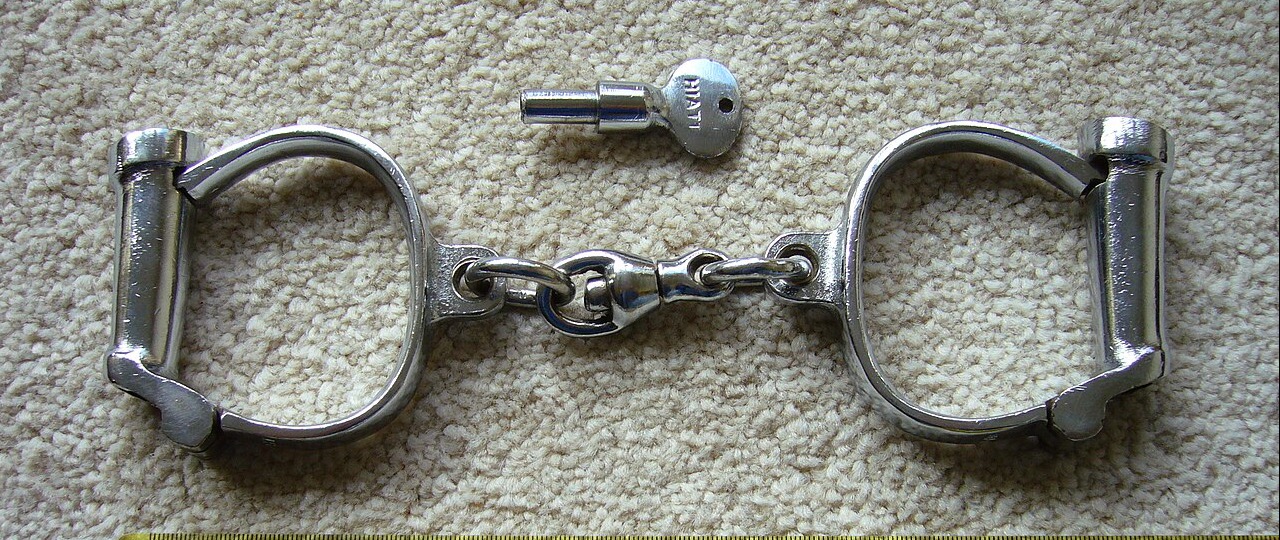
Thomas Griffin Hiatt made handcuffs in Birmingham. The firm that carried his name, Hiatt and Company, went on making them on the same Birmingham street for almost a hundred years after his death, and Hiatt handcuffs are still sold today. He was the father of Richard Thomas Hiatt, the chronometer maker, and the great-great-grandfather of Edith Hiatt.
Bromsgrove and Halesowen
Thomas Griffin Hyatt, son of Richard and Elizabeth, was baptized on January 1, 1785, at St. John the Baptist, Bromsgrove, in Worcestershire, about thirteen miles south of Birmingham. His age at his death points to a birth in 1783, so he was probably about two when he was baptized.
On Christmas Day, 1804, Thomas married Elizabeth Wall at Halesowen, another Worcestershire town on the edge of Birmingham. Elizabeth was also born about 1783. They settled in Birmingham, and all five of their children were baptized at St. Martin's, the old parish church of the town:
- Richard Thomas, baptized June 10, 1808
- Elizabeth, baptized August 2, 1810
- William John, baptized November 16, 1812
- Henry James, born June 2, 1816, baptized June 19, 1816
- Charles Wall, born June 4, 1821, baptized October 22, 1822
Handcuffs and Felons' Irons
Birmingham at the turn of the 1800s was a town of small metal workshops, and Thomas went into one of its grimmer trades. By 1813 he was a partner with Thomas Griffin and James Nicholls in a firm called Thomas Griffin and Company, makers of handcuffs, horse locks, felons' leg irons, steel horse collars, dog collars and D locks. In March 1813 Thomas Hiatt left the partnership.

NOTICE is hereby given, that the Partnership lately subsisting and carried on between Thomas Griffin, Thomas Hiatt, and James Nicholls, of Birmingham, in the County of Warwick, Handcuff, Horselock, Felon's Log Irons, Steel Horse Collar, Dog Collar, and Dee Lock Makers, under the Firm of “Thomas Griffin and Company,” was and stands dissolved on and from the ninth Day of March inst. so far as respects the said Thomas Hiatt. All Debts due and owing to and from the said dissolved Partnership will be received and paid by the said Thomas Griffin and James Nicholls. Witness the Hands of the said Parties the 23d Day of March, 1813, THOMAS GRIFFIN, THOMAS HIATT, JAMES NICHOLLS. Signed in the Presence of CLEMENT INGLEBY.
Who was Thomas Griffin?
Thomas Griffin Hiatt carried the full name of the senior partner in the firm he worked in. That is not likely to be a coincidence. Thomas Griffin may have been a relative, perhaps his grandfather or an uncle on his mother's side, or a godfather or a master to whom he had been apprenticed. Later accounts of Hiatt and Company say the firm was founded in Birmingham in 1780, three years before Thomas Griffin Hiatt was born. If so, it may have begun as Thomas Griffin's business and passed to Thomas Griffin Hiatt. No record has yet been found that says how the two men were related, or who founded the company in 1780.
Thomas went into business for himself. The New Triennial Directory of Birmingham of 1818 lists “Hiatt T. G. felons' irons and gate lock manufacturer, Moor-street.” In the same directory Griffin and Nicholls, makers of horse and dog collars, fetters and gate locks, were in Digbeth, where Thomas Griffin and Company had been.

In January 1825 Thomas Griffin Hiatt and his old partner James Nichols bought the iron foundry of the late William Payne of Sheep Street, to run alongside their own businesses.

IRON FOUNDRY.
THE Executors of WILLIAM PAYNE, late of Sheep-street, Iron-founder, inform the Merchants and Factors of Birmingham, that they have disposed of the above business to Messrs. NICHOLS and HIATT, and beg leave to recommend them to their future favours.
JAMES NICHOLS & THOMAS GRIFFIN HIATT take this opportunity of gratefully acknowledging the support they have received from their respective friends, and inform them, that they have purchased of Mr. WILLIAM PAYNE the above Iron-foundry Trade, which they will carry on in conjunction with their own, and respectfully solicit the support of their Friends in both businesses, assuring them that nothing on their part shall be wanted to merit the same. Birmingham, Jan. 22, 1825.
By 1835 Thomas had moved his works around the corner from Moor Street to 26 Masshouse Lane. The 1835 directory lists him there as a manufacturer of felons' irons, and James Nicholls at 63 Digbeth as a maker of handcuffs and irons. Thomas Griffin is no longer listed. He had probably died in the 1820s, for by 1829 James Nicholls was listed alone at Digbeth. 26 Masshouse Lane would be the home of Hiatt and Company for more than a hundred years.
Prisoners, Police and the Enslaved
Handcuffs and leg irons were bought by jails and prisons, and by the new police forces. In 1829 Parliament created the Metropolitan Police in London, the first modern police force in Britain, and other towns soon followed. Historians Joseph Yannielli and Christine Whyte write that Hiatt had a long-standing relationship with the London Metropolitan Police, and shipped “vast numbers” of fetters to America, India, China and continental Europe.
The same historians write that the firm “also made handcuffs, gang chains and collars for the enslaved, supplying the African slave trade well into the nineteenth century and long after it had been outlawed in Britain.” Britain outlawed the slave trade in 1807 and slavery itself in its colonies in 1834, but slavery went on in the United States, Brazil and Cuba for decades more. It is an uncomfortable part of the family story, but it is part of it.
The Locksmiths' Strike of 1835
In February 1835 the locksmiths and handcuff makers of Birmingham met and agreed to strike on April 6 unless their wages were raised. They printed a handbill appealing to the working people of the town. Thomas Griffin Hiatt and James Nichols answered it in Aris's Birmingham Gazette with a long notice of their own.

The men said they had suffered “a grievous reduction in the remuneration for our labour,” and had been forced on to the charity of other working people. The masters replied that they had cut prices only to compete with “small Saturday-night men,” that they were losing money on many of their goods, and that the men had never even come to ask for an answer. They went further:
… their earnings average from twenty-five to thirty-five shillings a week, when they work A WEEK, which is seldom, or we may say, never the case … But the true state of the case is this—they want to get as much money in three days as will support their families and supply them to get drunk and attend men-fights, dog-fights, &c. the other three days of the week. Their object in holding out is to compel us to send for them and make terms; this we are resolved not to do, if they never come into our employ again.
The notice was signed “THOMAS GRIFFIN HIATT, 26, Masshouse-lane, Moor-street; JAMES NICHOLS, 63, Digbeth, Birmingham, April 25, 1835.” How the strike ended has not been found.
The Children
Only one of Thomas's sons followed him into handcuffs. The others went their own ways.
Richard Thomas, the oldest, learned watchmaking and went to London while still a boy. He married there at seventeen and became a chronometer maker. His story, and the story of his sons who went to America, is on his own page.
Elizabeth, the only daughter, married John Slaney, a wine merchant of Wellington, Shropshire, at St. Martin's on October 31, 1830. Their son, John Hiatt Slaney, was born the next year. Elizabeth died at Wellington on September 29, 1844, of inflammation of the bowels.

On Sunday morning last, aged 35, Elizabeth, the beloved wife of Mr. John Slaney, wine merchant, of Wellington, Salop, only daughter of Mr. Thomas Griffin Hiatt, of Birmingham.
William John stayed home and went into the business. He married Hannah Miles at St. George's, Birmingham, in 1846, and in the 1851 census he was a handcuff and lock manufacturer. He had two children, William John Thomas, born 1849, and Hannah Elizabeth, born 1851.
Henry James, like Richard, became a chronometer maker. He married Isabella Turner in Birmingham on December 26, 1839, and lived for a few years in Kennington, near London, where Richard also lived. By 1845 he had moved north to Birkenhead, across the Mersey from Liverpool, and later to Prescot and to Liverpool itself. He named one son Thomas Griffin Richard Hiatt, after his father and his brother, but the baby died in 1842. Another son, Charles Wale Hiatt, was probably named for his uncle Charles Wall. Richard followed Henry to Liverpool in the 1860s. Henry died there on September 29, 1877.
Charles Wall, the youngest, carried his mother's maiden name. He became a solicitor, a lawyer, and settled in Wellington, Shropshire, where his sister had lived. In 1868 he married Elizabeth Williams there. She was the principal of a school for young ladies, The Limes. Their son Charles T. J. Hiatt was born in 1870.
His Death and Will
Thomas Griffin Hiatt died on Sunday, March 7, 1847, at 26 Masshouse Lane, where he lived and worked. He was 64. His son William was with him. The death record calls him a handcuff maker and gives the cause as disease of the mucous coat of the bladder and an enlarged prostate gland. The Birmingham Journal said he had borne “a long and painful illness” with patience.

On Sunday, after a long and painful illness, which he bore with exemplary patience and resignation to the Divine will, Mr. Thomas Griffin Hiatt, of this town, in the 64th year of his age.
His will was proved in the Prerogative Court of Canterbury. He left everything to his wife, Elizabeth, and then to his sons William and Charles, and after them to their children, none of whom had yet been born. Richard and Henry, who had both left Birmingham, were not among the heirs.
Elizabeth died on January 4, 1858, at about 75. Thomas, Elizabeth and their son William are buried together in Key Hill Cemetery, Birmingham.
Hiatt and Company
After his father's death William John ran the business. The 1858 directory describes him grandly:

Hiatt William John, (successor to the late Thos. Griffin Hiatt) handcuff manufcr to Her Majesty's Honorable Board of Ordnance, and original manufacturer of all kinds of police and other handcuffs, police leg, and travelling irons, police staves, sabres, pistols, rattles, and lanterns, 26, Masshouse ln; h, Moseley rd, Balsall heath.
William John did not have long. He died on December 9, 1859, only twelve years after his father.

On the 9th inst., Mr. William John Hiatt, lock manufacturer, of Masshouse Lane, in this town.
The firm outlived the family that founded it. As Hiatt and Company it came to specialize in handcuffs, forged from steel and finished by hand. Police forces in Britain and around the world used them. The company stayed at 26 Masshouse Lane until the night of April 8, 1941, when German bombs destroyed the building. After the war it moved to Baltimore Road, Great Barr, on the north side of Birmingham.
In 1986 the company set up Hiatt-Thompson in Bedford Park, Illinois, to sell its handcuffs in the United States and Canada. In 2005 human rights campaigners picketed the Birmingham works over handcuffs and shackles sent to the American prison camp at Guantánamo Bay, Cuba. In 2008 production moved to the United States, and the last fifteen jobs in Birmingham were lost. Since 2014 Hiatt handcuffs have been made and sold by the Safariland Group of Jacksonville, Florida.
One pair has ended up in a museum. In July 2009 Harvard professor Henry Louis Gates Jr. was arrested at his own front door in Cambridge, Massachusetts, after a neighbor reported a possible break-in. The handcuffs put on him were Hiatts, made in Birmingham by the company that had once made collars and chains for the enslaved. Gates gave them to the National Museum of African American History and Culture in Washington, D.C.
