Nicolas Leroy and Jeanne Lelièvre left Normandy for New France in 1661 with their two little boys and Nicolas's widowed mother. They farmed first on the Côte de Beaupré, below Quebec, and later on the south shore of the St. Lawrence, where their children grew up and raised families of their own.
Dieppe and Honfleur
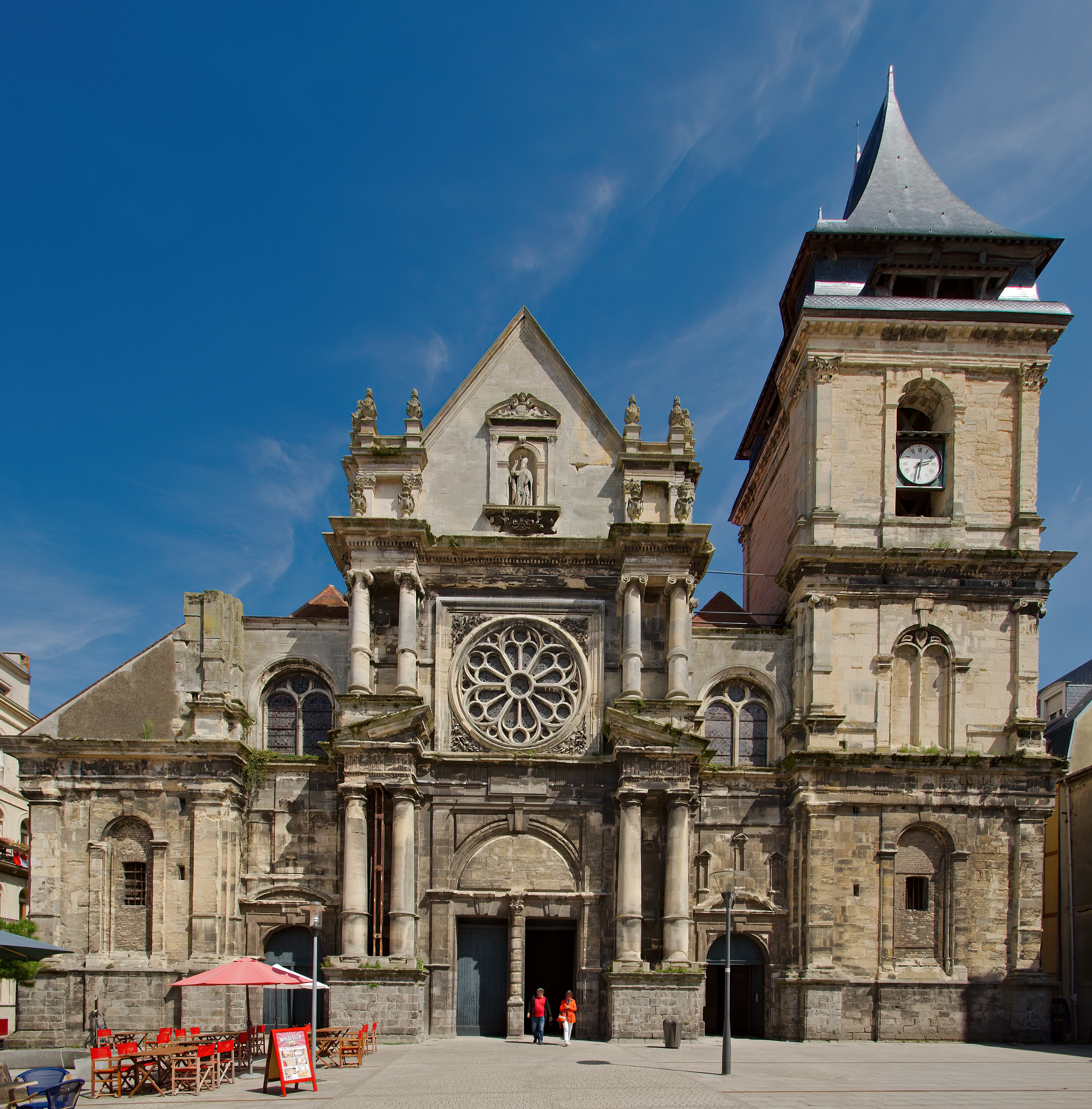
Nicolas Leroy was baptized on May 25, 1639, at the church of Saint-Rémy in Dieppe, a port on the coast of Normandy. He was the son of Louis Leroy and Anne Lemaistre, who had married at Saint-Rémy the year before.


Jeanne Lelièvre was about five years older. She was baptized on March 22, 1634, at Honfleur, across the mouth of the Seine from Le Havre, the daughter of Guillaume Lelièvre and Judith Riquier. Her parents were not married, and the priest wrote in the margin that she was illegitimate.
Nicolas and Jeanne married in Dieppe in February 1658. Their first son, Louis, was baptized at Saint-Rémy on November 26, 1658, and their second son, Nicolas, on March 24, 1661.
The Crossing, 1661
Jeanne's father, Guillaume Lelièvre, had gone to New France several years earlier, and he sent back word of how good life was there. He married again at Quebec on August 21, 1660, to Marguerite Meillet.
Nicolas's father had died, and his mother, Anne, decided to go too. To pay for the voyage Nicolas borrowed 50 livres from Jean Gloria, a merchant of Dieppe, in a contract signed before two notaries on June 17, 1661. He promised to repay the money eight days after he arrived in Canada. Jean Gloria was godfather to little Nicolas, and he also went to New France.
The family sailed on a ship commanded by Laurent Poulet. Louis was about two and a half, and Nicolas was a baby of three months. The Journal des Jésuites, a diary kept by the Jesuit priests at Quebec, notes that Nicolas Le Roy arrived in the country on August 22, 1661.
The Côte de Beaupré
Nicolas worked at first in the seigneury of Beaupré, on the north shore of the St. Lawrence below Quebec. On June 8, 1664, Guillemette Hébert granted him land there, two arpents wide along the river and a league and a half deep. Each year he owed the seigneury 12 deniers for each arpent of frontage, 20 sols of rent and three live capons, and he had to have his grain ground at the seigneur's mill. The land lay east of Montmorency Falls and west of L'Ange-Gardien, in what is now Boischatel. Nicolas cleared it and built a house.
The census of 1666 lists the family on the Côte de Beaupré with four children and a hired man, Jean Brière. A year later they had five children, four head of cattle and seven arpents of cleared land.
Nicolas's mother, Anne Lemaître, married again at Quebec on November 7, 1663. Her new husband was Adrien Blanquet, a settler on the Île d’Orléans. At the signing of their marriage contract on October 25, Nicolas and Jeanne stood with her, and Nicolas signed his name.
Two Tragedies
In the summer of 1669 a neighbor, Jacques Nourry, a man of 29, found Nicolas and Jeanne's little daughter Marie, born August 15, 1664, alone and raped her. Three doctors examined her and confirmed it. On August 19, 1669, the Sovereign Council at Quebec sentenced Nourry to be hanged, and the sentence was carried out the same day. After his death his head was cut off and set on a post in a public place, “to give thought to those who would avoid marriage.” He was also ordered to pay 300 livres to Marie and 100 livres in damages.
Marie grew up and lived a full life. She married Jean Gaudreau in 1679 and had three children with him, and after his death she married Jean Fournier and had ten more. She died in 1751.
The next summer brought another loss. On July 6, 1670, the family's house burned, and the two youngest children, Anne, who was about two, and Jean, a baby of eight or nine months, died in the fire. They were buried inside the church of L'Ange-Gardien.
The South Shore
Between 1674 and 1676 the family moved across the river to the seigneury of La Durantaye, on the south shore, in the area that later became the parishes of Beaumont and Saint-Michel. Guillaume Lelièvre found work at Beaumont in September 1675, and Nicolas and his family followed him. By 1676 Nicolas was living and farming in the seigneury.
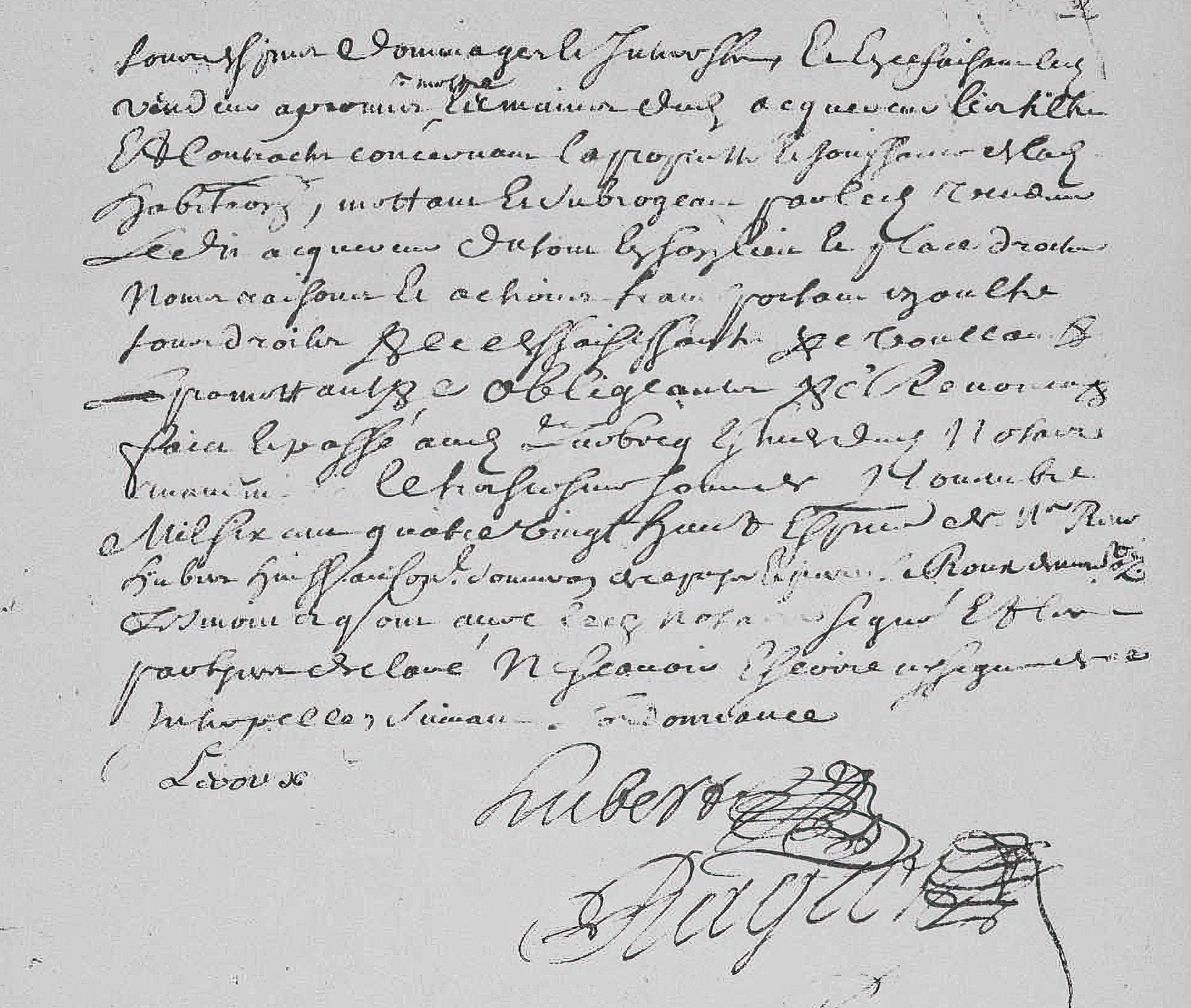
In the summer of 1677 the notary Romain Becquet began writing a four-year lease between Nicolas and the seigneur, Olivier Morel de La Durantaye, who lived in Quebec. The lease was never finished or signed, but it shows what Nicolas was doing. He was the farmer of the seigneur's own domain, the manor farm of La Durantaye, with its house, barn, stable, courtyard and garden, its plowed fields and meadows, and the right to hunt and fish on the land. The lease says that he already knew the farm well, having lived on it as its farmer for more than a year. Each year he was to pay the seigneur 20 minots of wheat and 6 of peas, “good, clean and merchantable grain,” and four capons, at Martinmas in November and on the first of June. He had to keep the buildings and fences in repair and could not pass the lease to anyone else. If the seigneur decided to come and live on his land, Nicolas and his family would move out of the house into another building on the farm.
On March 30, 1679, Nicolas sold his land on the Côte de Beaupré to Jacques Marette and René Brisson for 500 livres. He signed the deed himself. The census of 1681 found him at La Durantaye with four children still at home, a gun, eight head of cattle and 20 arpents of cleared land. His older sons Louis and Nicolas lived nearby.
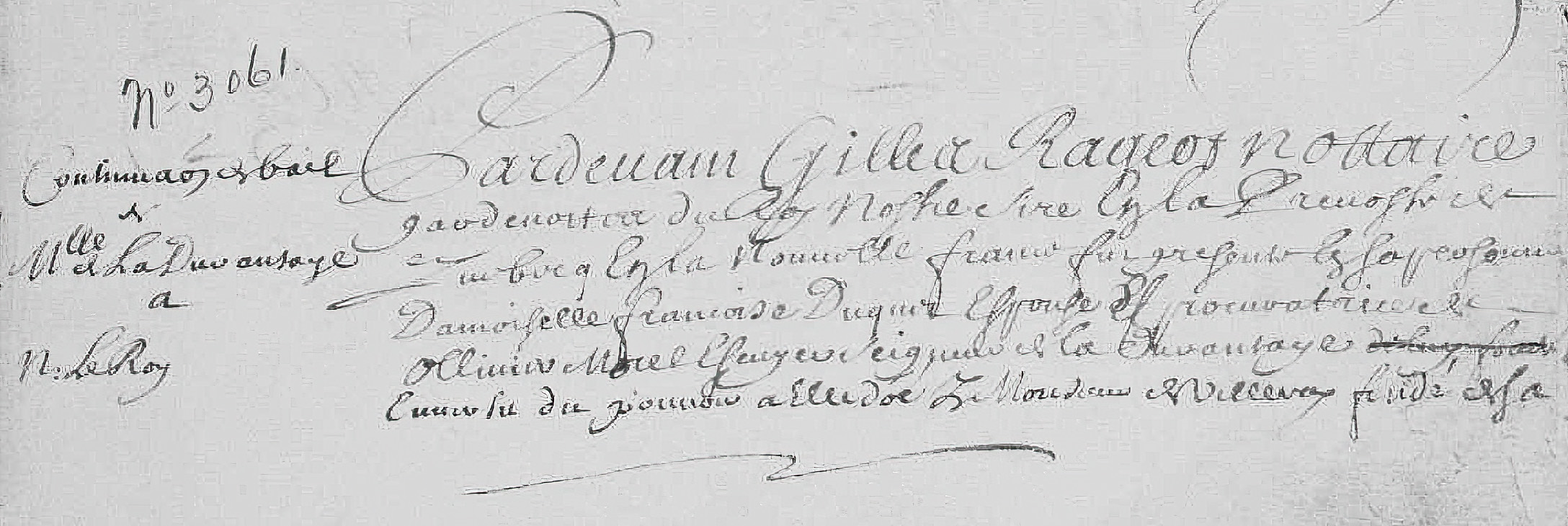
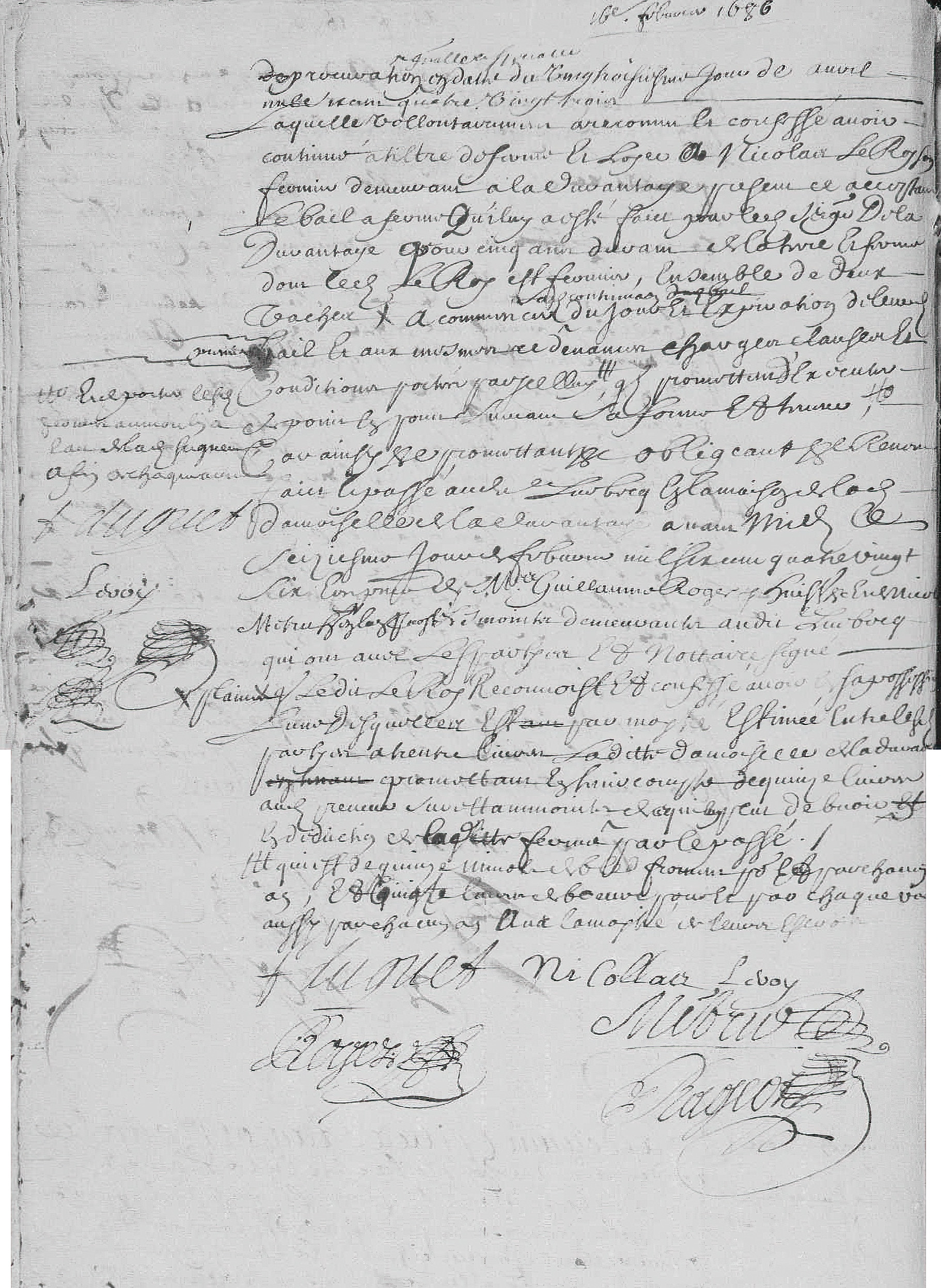
Nicolas was still the seigneur's farmer nine years later. On the morning of February 16, 1686, he went to the house of Françoise Duquet in Quebec. She was the wife of Olivier Morel and managed his affairs, and before the notary Gilles Rageot she renewed Nicolas's lease of the farm for five more years, with two cows. Each year he was to pay 15 minots of wheat and 20 pounds of butter for each cow, and bring the wheat to the seigneury's water mill. Nicolas signed his name, “NiCollas Leroy.” It is the last record of him alive.

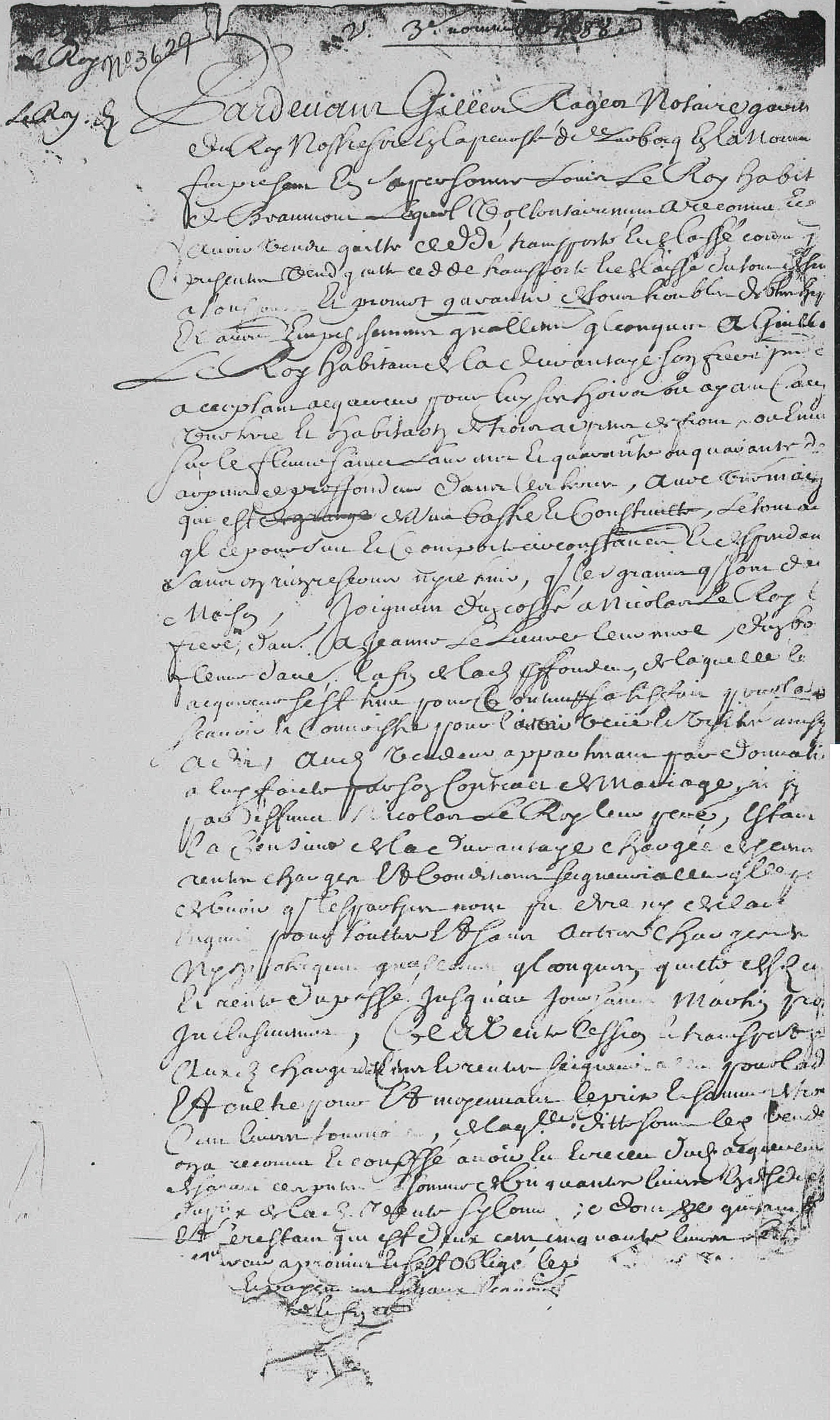
He died within the next two years, at about 48, and his burial record has not been found. On November 3, 1688, his son Louis, of Beaumont, sold his brother Guillaume a farm three arpents wide and forty or forty-two deep, with a house on it, for 300 livres. Louis had received the land from “the late Nicolas LeRoy, their father,” in his marriage contract. The deed shows how the family had settled side by side: the land lay between the farms of their brother Nicolas and of “Jeanne Le Lievre, their mother.” Neither brother could sign his name.
Jeanne's Later Years
Jeanne lived on for forty years after Nicolas. On February 8, 1695, at the age of 60, she married François Molinet dit Tourangeau, about 43, at the church of Saint-Étienne in Beaumont. He died at the Hôtel-Dieu hospital in Quebec on June 12, 1702, and was buried the same day, perhaps a victim of the smallpox that was spreading through the colony that year.
On October 22, 1707, Jeanne sold a farm in La Durantaye, three arpents wide by forty deep, to Martin Leblanc for 600 livres. She could not sign her name.
Jeanne died in January 1728, at about 93, and was buried on January 11 at Saint-Vallier, where her son Nicolas had lived. The priest, Leclair, wrote that she died without any illness, that she had received the last sacrament eight days before as a precaution, and that the whole parish came to her burial.
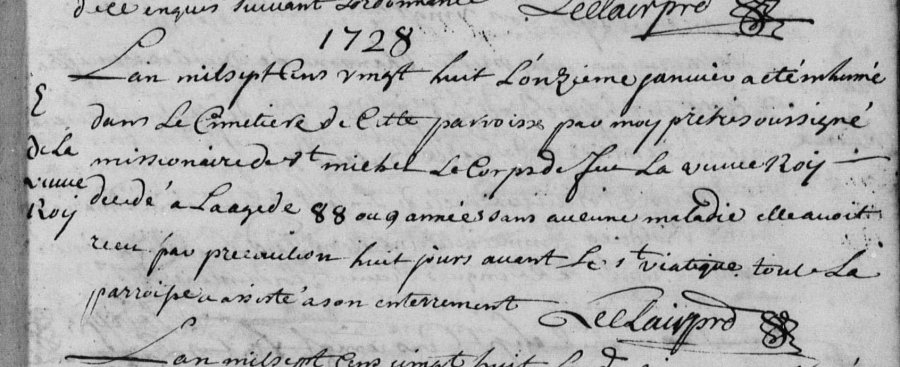
Burial of the widow Roy (translated from the French)
In the year one thousand seven hundred twenty-eight, the eleventh of January, was buried in the cemetery of this parish, by me, the undersigned priest, missionary of Saint-Michel, the body of the late widow Roy, who died at the age of 88 or 9 years without any illness. She had received the holy viaticum as a precaution eight days before. The whole parish attended her burial.
Leclair, priest
How old was Jeanne, and how did she die?
The burial record gives her age as “88 or 9 years.” Her baptism at Honfleur on March 22, 1634, makes her 93. Ages at death were often guesses, especially for someone who had outlived most of the people who knew when she was born.
Jacqueline Sylvestre Lapierre's transcription of the burial, and The French-Canadian Genealogist, say she was found dead sitting in her chair. The record shown here does not say that; it says she died without any illness. The chair may come from another copy of the register, or from family tradition.
Their Children
| Child | Born | Died |
|---|---|---|
| Louis | baptized November 26, 1658, Dieppe | 1705 |
| Nicolas | baptized March 24, 1661, Dieppe | February 4, 1727, Saint-Vallier |
| Noël | about 1662 | 1731 |
| Marie Jeanne | August 15, 1664 | 1751 |
| Guillaume | about 1666 | 1743 |
| Anne | 1668 | July 6, 1670, in the fire |
| Jean | 1669 | July 6, 1670, in the fire |
| Élisabeth (Isabelle) | 1671 | not known |
| Jean | 1674 | 1742 |
| Jean Baptiste | 1678 | 1743 |
No baptism record has been found for Noël. His birth year comes from the 1666 census, which gives his age as three, so he was probably born soon after the family arrived.
Three Lines to Patty Roy
I (Patty Roy) can trace my ancestry back to Nicolas and Jeanne through three of their children:
- Noël, the line my last name comes from:
- Nicolas Leroy, 1639–before 1688
- Noël Roy, 1662–1731
- Augustin Roy, 1710–1775
- François Roy, 1749–1817
- Pierre Roy, 1786–1857
- Régis Roy, 1817–1897
- Alfred Peter Roy, 1865–1938
- Leo Roy, 1900–1989
- Nicolas, an ancestor of Amanda Beaudoin, Alfred Peter Roy's wife, whose mother was Henriette Roy.
- Élisabeth (Isabelle), another ancestor of Amanda Beaudoin.