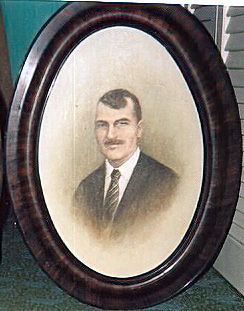
Alfred Peter Roy was born Pierre Alfred Roy in Rimouski, Quebec, in June 1865. As a young man he went west to Minneapolis, where he married Amanda Beaudoin, and in the 1890s the couple settled in the Norwood section of Warwick, Rhode Island. There he built houses, raised pigs and vegetables, raised a large family, and more than once found himself in the newspapers. He was the father of Leo Roy.
Rimouski, Quebec
Alfred's parents were Régis Roy, a farmer, and Philomène Dubé. He was baptized at the cathedral of Saint-Germain in Rimouski, a town on the south shore of the St. Lawrence River, with the name Pierre Alfred Roy. In Quebec a child was often given a saint's name first and called by the second name, so Pierre Alfred was known as Alfred. In the United States the order was turned around, and he became Alfred Peter Roy, or Alfred P. Roy.

The entry, written in French by the priest, reads in English:
B 76 Pierre Alfred Roy
On the eighteenth of June, eighteen hundred sixty-five, we the undersigned priest, vicar of this parish, have baptized Pierre Alfred, born the day before, of the legitimate marriage of Régis Roy, farmer, and of Philomène Dubé of this parish. Godfather Pierre Lepage, undersigned; godmother Béatrix Banville, who cannot write; the father absent.

Born June 16 or June 17?
Alfred's obituary gives his birthday as June 16, 1865, and that is the date the family has always used. But the baptism entry, written on June 18, 1865, says he was born “la veille,” the day before, which would be June 17. The baptism was recorded within a day of the birth by the priest who performed it, so it is the best evidence for the date. The obituary's date was given by the family 73 years later. Leo, Alfred's son, was born on June 16, 1900.
Minneapolis
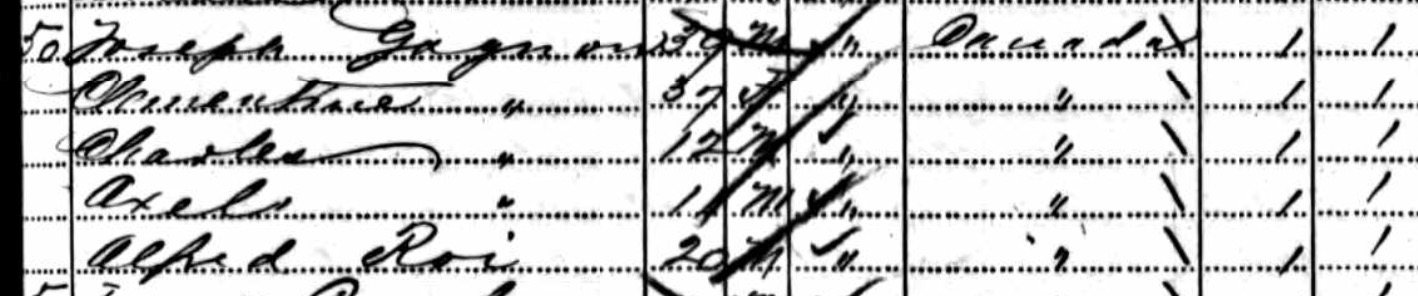
By 1885, when he was about twenty, Alfred had left Rimouski for Minneapolis, Minnesota. His sister Clémentine and her husband, Joseph Gagnon, had gone there in 1883, and in the Minnesota state census of 1885 Alfred Roi, age 20, born in Canada, is living in their household with Joseph, 39, Clémentine, 37, and their children.
Minneapolis had a large French-Canadian community on the east side of the river, around the old town of St. Anthony, and its parish church was Notre-Dame-de-Lourdes. The Minneapolis directory for 1891–92 lists Alfred Roy, laborer, living at 717 University Avenue Northeast. Etienne Beaudoin, the janitor of the Notre Dame de Lourdes School, lived in the same building. Etienne would soon be Alfred's father-in-law.


Amanda Beaudoin was already living in Minneapolis with her parents, and some of her brothers and sisters at 1004 Northeast Second Street.

A Wedding at Notre-Dame-de-Lourdes
Alfred and Amanda were married on Tuesday, April 14, 1891, at Notre-Dame-de-Lourdes church. The church, built in the 1850s and bought by the French-Canadian Catholics in 1877, still stands and is the oldest church building in Minneapolis in continuous use. Two papers carried the news, the French-language Écho de l'Ouest and the Minneapolis Tribune.

Écho de l'Ouest, April 16, 1891 (translated from the French)
WEDDING.
Last Tuesday, at 9 am, at the Notre-Dame de Lourdes church took place the wedding of Mr. Alfred Roy with Ms. Amanda Beaudoin.
The nuptial blessing was given by the Rev. Father Soumis, parish priest.
Mr. Joseph Beaudoin, brother of the bride, and Ms. Amanda Cloutier acted respectively as best man and maid of honor.
In the evening, at the residence of the father of the bride, Mr. Etienne Beaudoin, there was a magnificent reception, which more than a hundred people attended.
Our best wishes for happiness and prosperity to Mr. and Mrs. Roy.

Minneapolis Tribune, April 19, 1891
Last Tuesday morning at the Church of Notre Dame de Lourdes, Miss Amanda Beaudoin and Alfred Roy were united in marriage by Rev. Father Soumis. The attendants as bridesmaid and groomsman were Miss Amanda Cloutier and Joseph Beaudoin. A reception was tendered the couple in the evening at the residence of the bride's father, Etienne Beaudoin.
Superior and Rhode Island
Amanda's father, Etienne Beaudoin, died of pneumonia in 1892, and the couple moved to Superior, Wisconsin, at the western tip of Lake Superior. According to the family, Alfred found work with the railroad there. Their daughters Anna and Dora were born in Superior in 1894 and 1895.
Their next child, Alfred Joseph, was born in Rhode Island in 1896. The family story is that Amanda wanted to be near her sister Delphine, who had moved to Rhode Island with her husband, François Bouchard, in 1891. Amanda's sister Delima and her husband, Achille Lavoie, also moved from Superior to Rhode Island at about the same time as Alfred and Amanda.
Some of the children of Alfred's brother Samuel came to New England too. Samuel's daughter Marie Reine Hosanna Hectorine, who married William Reilly, was in Rhode Island by 1911, when her first child was born, and his daughter Marie Alice, who went by Alice and married Fred Charboneau, was there by 1914. His son Joseph Alphonse Roy, who married Florida Sawyer, was in Rhode Island by 1926, when his first child was born, and lived in Warwick. Another daughter, Fontina, who went by Marion, was in Fall River, Massachusetts, by 1904, when she married Derias Mimeault there, and she lived mostly in Fall River.
Ten Children
Alfred and Amanda had ten children. Eight of them lived to grow up.
| Child | Born | Died |
|---|---|---|
| Frank | unknown | unknown |
| Anna Marie | January 13, 1894 | July 5, 1938 |
| Dora Marie | July 20, 1895 | September 13, 1978 |
| Alfred Joseph | September 23, 1896 | February 4, 1957 |
| Yvonne Alice | February 22, 1898 | April 17, 1971 |
| Leo Regis | June 16, 1900 | February 25, 1989 |
| Napoleon Charles | May 8, 1902 | June 10, 1995 |
| Louis Auguste | August 14, 1904 | December 1968 |
| Emil | May 17, 1908 | April 25, 1909 |
| Eugene Emil | June 27, 1909 | September 12, 1987 |

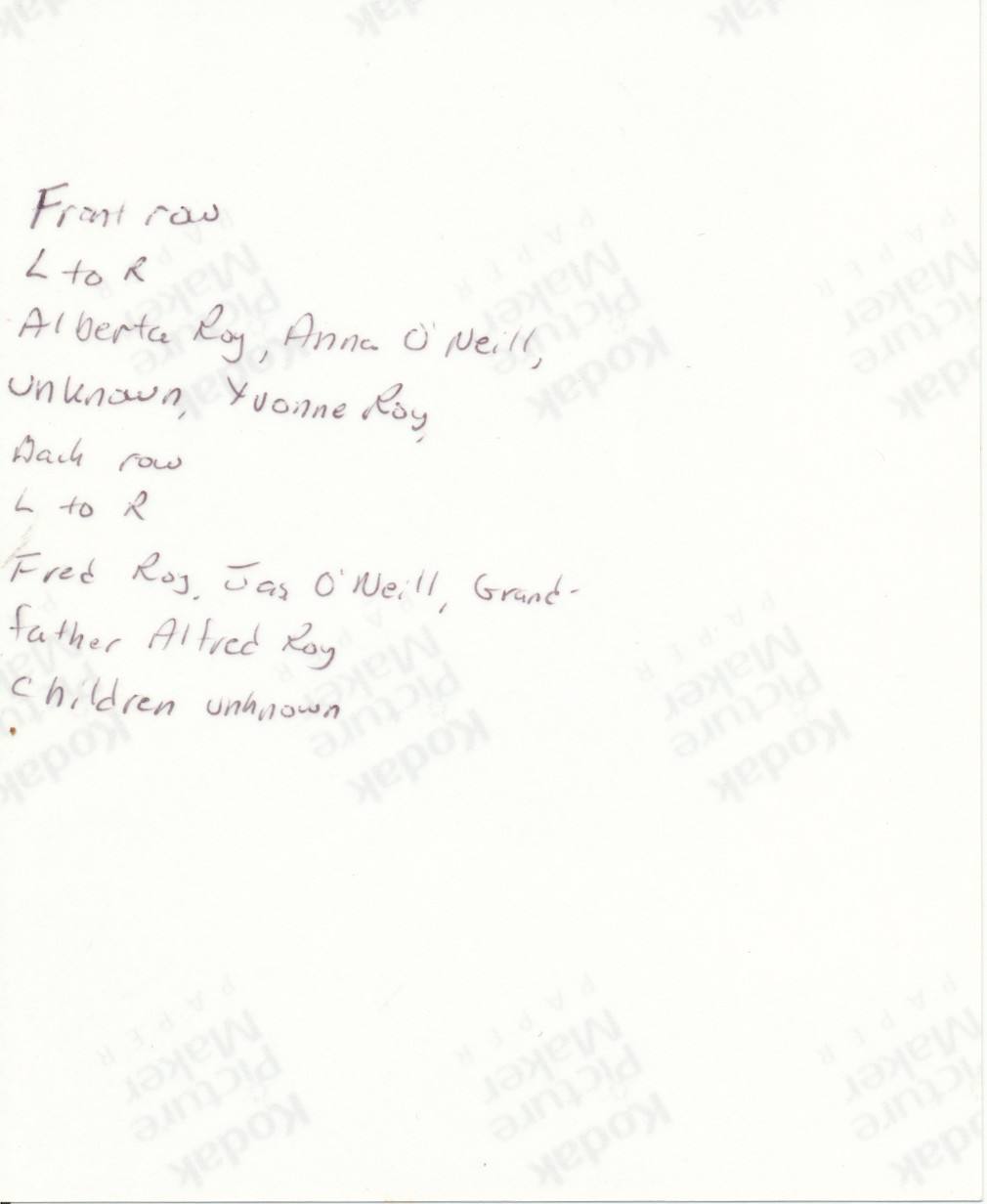
This photograph shows Alfred, in the back row on the right, with three of his grown children and their families. Someone wrote the names on the back:
Written on the back of the photograph
Front row, L to R: Alberta Roy, Anna O’Neill, unknown, Yvonne Roy.
Back row, L to R: Fred Roy, Jas O’Neill, Grandfather Alfred Roy.
Children unknown.
- Fred Roy, at the left of the back row, was Alfred Joseph Roy, Alfred's oldest son, born in 1896. Alberta Roy, who sits in front of him, became his wife on May 2, 1921.
- Anna O’Neill, second from the left in front, was Alfred's oldest daughter, born in 1894. Her husband, Joseph O’Neill, stands behind her. The back of the photo calls him “Jas,” which is usually short for James.
- Yvonne Roy, at the right end of the front row, was Alfred's daughter, born in 1898. Alfred stands behind her.
The children are not named. Anna had a son, Francis, born September 22, 1915, and a daughter, Dorothy, born December 13, 1916, and the two children are probably hers. The child on Anna's lap looks about two years old, and the one held by the unknown woman looks about a year old, so if they are Francis and Dorothy, the older one on Anna's lap would be Francis and the younger one Dorothy. That would date the photograph to about late 1917 or early 1918, when Francis was about two and Dorothy about one.
The names on the back do not settle the date. Yvonne is listed by her maiden name, Roy, though she married on April 5, 1921. Alberta is listed by her married name, Roy, though she and Fred did not marry until May 2, 1921, a month after Yvonne. Whoever wrote the names seems to have used the names they knew the women by, not the names they had on the day of the photograph. If the photo was taken before April 1921, Alberta was not yet Fred's wife, perhaps his sweetheart or fiancée. The women's dresses, with loose waists and hems at mid-calf, and their hair, fit the years around the end of the First World War.
When was the photograph taken?
The back of the photo does not give a date, and the names on it cannot both be right for the same day: Yvonne was a Roy only until April 5, 1921, and Alberta became a Roy only on May 2, 1921.
If the children are Francis and Dorothy, their sizes point to late 1917 or early 1918, and Alberta was in the family picture three years before her wedding. If the photo was taken after Fred and Alberta married, Francis would have been at least five and Dorothy at least four, much older than the children in the picture, so the children would be someone else's. The clothes fit either time. The first explanation fits the children best, but without a date on the photo, it cannot be proved.
Carpenter, Pig Farmer and Market Gardener
In the 1905 Rhode Island census and the 1910 and 1920 federal censuses Alfred was a house carpenter. The 1905 census also says that he could not read or write. By 1930 the census lists him as a farmer on a truck farm, a farm that raised vegetables for market, and the 1935 Rhode Island census also calls him a farmer. When his son Leo married, the wedding announcement called the family business Roy & Sons, market gardeners. Alfred kept pigs as well, and fed them, and his fields, with swill, the food scraps that farmers collected from kitchens and hotels. The pigs got him into the papers.
The Pig Man and the Ice Man, 1905
In January 1905 a quarrel over a rented lot in Norwood made the front page of the Providence Evening Bulletin.


Read the full article
HELD PROPERTY WITH SHOT GUNS, AXES AND CLUBS.
Warlike Episode in Norwood Over Lease of Land.—The Pig Man Was in Possession When the Ice Man Invaded the Premises.—There Was a Swine Hunt and Other Exciting Things, but Finally Peace Prevailed and the Pig Man Will Harbor His Porkers Elsewhere.
Norwood was in a state of warlike […] yesterday. A strong party of defenders armed with shotguns, axes and clubs for a time held at bay an invading force until victory perched upon their banner and the hostile demonstrations were called off.
The cause of the conflict, which […] fair at […] time to become of a sanguinary […] later, was a misunderstanding about a lease, it is said. Last July, according to Charles R. McKenna, attorney for Alfred Roy, the latter [leased] a plat of land, near the Pawtuxet River bridge on the East Greenwich electric car line, of William Leonard, the owner of the estate. Roy started to raise pigs, and in the fenced-in enclosure […] big fat porkers have disported themselves through the winter months until the present time.
Thursday night Mr. Roy went to his home after work, and, passing his “pig farm,” he stopped to inspect the drove. To his astonishment he found a big building in process of construction in the enclosure, and, looking about his fences, saw that they were broken down. The 65 pigs were having the time of their lives, and the Norwood dogs were having a holiday hunt. He looked about in amazement, rubbed his eyes and looked again. Down the wind came the […] of a pack in full cry on […], and a moment later a […] fat forms ambled past with deceptive speed squealing derisively at […] leaping with clamorous pups on the trail. The pursued and pursuers disappeared in the gathering dark, and Roy again rubbed his eyes and turned to view the place which he had so carefully enclosed with a fence.
After a few pertinent inquiries of the men at work, he found that the building, which was going up on the plot, was to be used as an ice house and that it was being constructed by M. J. W. De Ware, ice dealer of 154 Burns street, this city. It was claimed that the latter had leased the property from the landlord. Mr. Roy produced his rental form in dispute of that claim, and, returning to the plat, spent the night in re-establishing his fences after the carpenters left.
Then he went to the office of Charles R. McKenna, attorney, and the latter, with five men, went to the scene yesterday morning, determined to guard the property against invasion. The little band held the fort by force from 6:30 o'clock yesterday morning till 2 o'clock in the afternoon. The iceman's workmen arrived and found the defenders firmly entrenched behind the fences and the partly completed ice house. Axes and clubs were waved ominously, and the workmen held a parley. Finally a flag of truce was displayed, and a conference was held, which resulted in the determination to consult the landlord, and consequently emissaries of each side called upon Mr. Leonard. He informed the parties that he had let the plat to Mr. Roy for the season, and considered that the season ended at the close of the warm weather. Mr. Roy insisted that he had leased the plat for a year, and the situation on the return to the plat assumed warlike proportions again.
The iceman said he would see his lawyer, and went away for a time. The pickets on each side watched each other narrowly, and the strain was only relieved by the flight of some fear-stricken pig through the lines. Mr. De Ware returned at 10:30 o'clock, and ordered his men to go to work at once. Mr. McKenna's men prepared for a defensive battle. Mr. Roy appeared with two double-barrelled shotguns, and, it is claimed, threatened to blow off the top of the head of any man who ventured on the plat.
The iceman at once […] and went for an officer, to whom he preferred a charge of assault against Mr. Roy. Constable Knox went with him to the scene, but, it is said, found that the plat was located in the town of Warwick, and that he could take no action.
After a time hostilities were suspended by a meeting in the office of Attorney McKenna, who said to-day that the landlord settled with Mr. Roy for $85, and that the iceman took the property for his ice house.
In the end the landlord paid Alfred $85, and the ice dealer got the land. As the headline put it, the pig man would “harbor his porkers elsewhere.”
More Trouble in Norwood
In June 1908 some of Alfred's Norwood neighbors complained to the Warwick town council about his “piggery” on Apponaug Road.

The News-Democrat, June 23, 1908
The complaint of John M. Tourtellot, C. A. Brigham and others of Norwood against a “piggery” maintained on the Apponaug road, between Lincoln Park and Norwood, by Alfred P. Roy, was received, alleging that the place was a nuisance and a menace to health. It was referred to Dr. John A. Mack, health officer, with instructions to report at the next meeting.
In 1914 he was in court for keeping three of his children out of school.

HAD TO PAY THE COSTS
Alfred Roy, who was arrested a week or more ago on complaint of Truant Officer John J. Hargraves for keeping his three children from school, was adjudged probably guilty to-day by Judge Hebert in the Fourth District Court at Apponaug and sentence was deferred on payment of costs.
In 1922 the swill he used on his fields became a town political fight.


TOWN COUNCIL TO INVESTIGATE WELLS AT OAKLAND BEACH
The Warwick Town Council voted at a special meeting at Apponaug last night to have an investigation of the condition of several wells at Oakland Beach. A resolution was also adopted ordering the removal of a garbage nuisance at Norwood, after a petition signed by about 70 residents of the village was presented to the Council.
James Mohr, in speaking in behalf of the petitioners stated that the dumping of swill on the property of Alfred P. Roy by Mr. Roy and others constituted a nuisance. The odor from the garbage heap, according to Mr. Roy and others, is very disagreeable, and dangerous to the health of the community. During the discussion of the alleged nuisance Orrin Hebert complained of the number of rats that infest the garbage heap and stated that he has had to stay up nights shooting them.
HOT POLITICS IN WARWICK WITH SWILL ON SIDE — Council President Harrington Not One with Norwood Citizens
If one can judge by the comment heard in Norwood in regard to Council President Harrington instructing the sergeant-at-arms to remove a taxpayer who had appeared before the council to defend himself, there is more than the desire to rid the town of serving as a dumping ground for swill. At a previous meeting the council president led the fight against Alfred Roy, who it appears has only six pigs, and what swill he brings into the town is used as fertilizer.
When an investigation was ordered and inspection made of the place complained of, it was found that the swill had been plowed in and not exposed as stated by the complainant, who it appears is a neighbor.
It will be recalled by many that this is the man that Harrington stopped on the highway for carting swill without a permit, and his posing as the health officer at that time caused a furor that threatened for a time to wreck the party. It is reported that State Committeeman Robertson and Health Officer Lockwood have had but little in common since then. It was stated at the time and probably used to defend Harrington that he had no intention to usurp the powers of the health officer when he stopped the swill team, but thought the driver was lost and was directing him to Lakewood where the political hogs live.
Harrington's action has stirred up the feelings of the Norwood citizens who are not in sympathy with such strong arm methods, frankly state that Harrington's mad desire for publicity will react against him next fall and his political career will be cut short.
Residents in Norwood who live near the highway and in a position to know, ask why Roy is being discriminated against when another resident who resides only a short distance from the council president is carting swill daily through Elmwood avenue in an uncovered wagon and at times with side boards used to keep some of it from dropping all over the street, while the wagon used by Roy conforms with the law and is covered completely.
From 1928 to 1932 Alfred was in court against the streetcar company. That story is told in Roy vs. United Electric Railways, 1928–1932.
Amanda and Adeliska
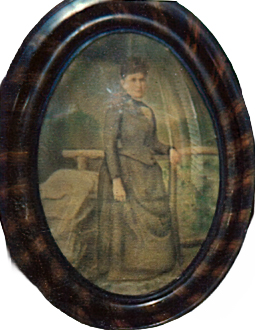
Amanda died on December 21, 1910, of a burst appendix. She was 41, and her youngest child, Eugene, was eighteen months old. Alfred was left with eight children at home, the oldest of them 16.
Alfred did not marry again for more than twenty years. In 1933, at 67, he married Adeliska Giroux of Providence. It was her first marriage. They lived at 25 Chestnut Street in Norwood, an area that is now industrial land off Jefferson Boulevard.
How old was Adeliska?
Three records give three different answers. The 1933 marriage record gives Adeliska's age as 54, which puts her birth in about 1879. Her death certificate gives her birth date as November 1, 1878. Her obituary gives the same day, November 1, but the year 1876, and says she was 78. The death certificate and the marriage record are close to each other, so 1878 seems the more likely year, and it is the one used on this page. If that is right, she was 54 or 55 at her wedding and 76 when she died.
His Death
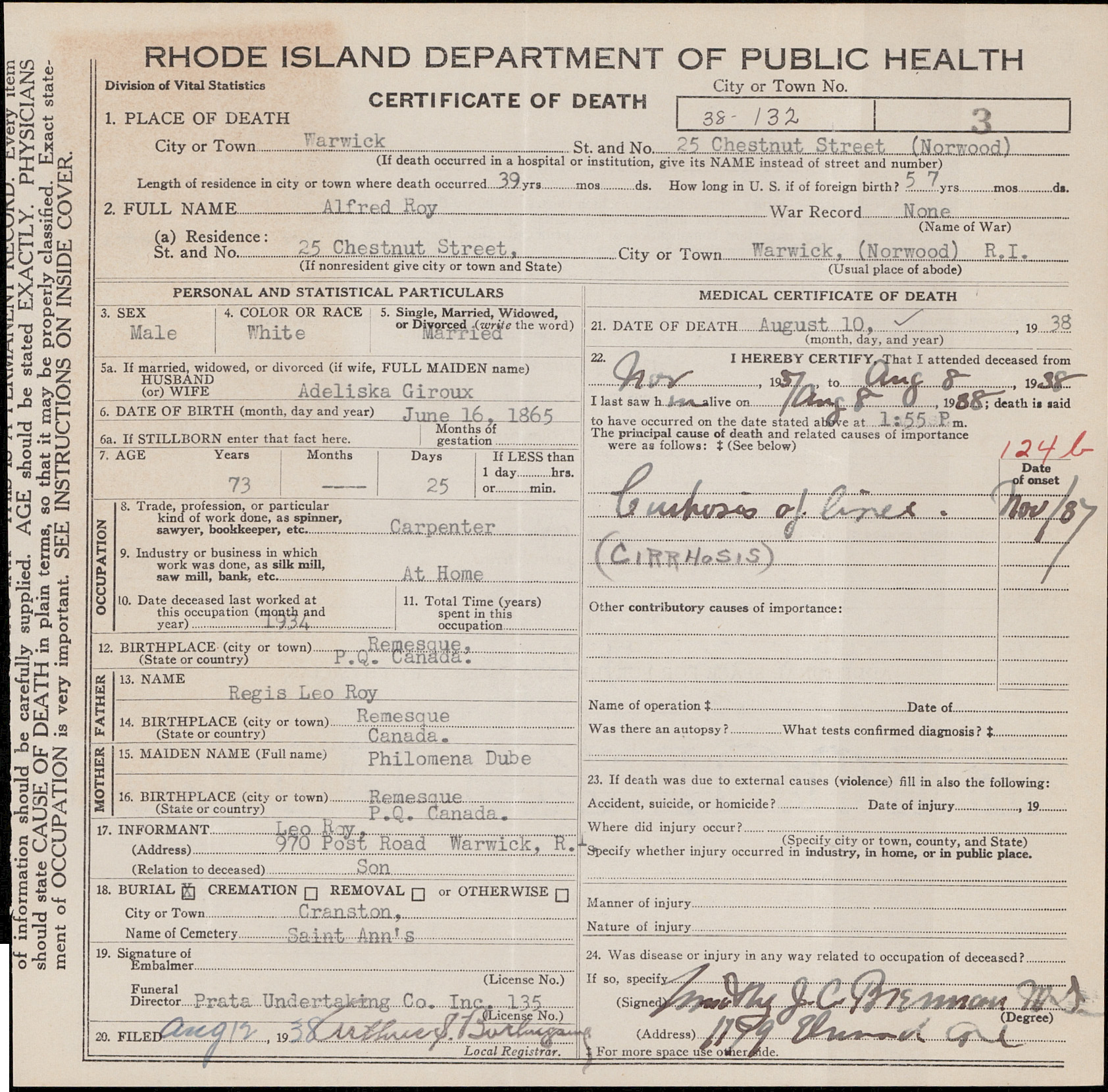
Alfred died at home, 25 Chestnut Street, on the afternoon of August 10, 1938, at 73. His death certificate gives the cause as cirrhosis of the liver, which it says he had had since November 1937. His daughter Anna had died just a month before, on July 5. He was buried with Amanda and their baby son Emil in St. Ann's Cemetery in Cranston, Section K, Lot 170.
His son Leo gave the information for the death certificate. It describes Alfred as a carpenter who had worked at home, last in 1934, and says he had lived in Warwick for 39 years.


Alfred Roy
Alfred Roy, 73, died late yesterday afternoon at his home, 25 Chestnut street, Norwood, following a long sickness. He is survived by his wife, Adeliska (Giroux) Roy; five sons, Alfred, Leo, Napoleon, Louis and Eugene, all of Warwick; two daughters, Miss Dora M. Roy and Mrs. Yvonne A. Hallene, both of Norwood, and by 10 grandchildren. The body was removed to the Prata Funeral Home, 1488 Westminster street, Providence. It will be taken to his home at Norwood this afternoon.
The funeral there Saturday morning at 8:15 o'clock will be followed by a high mass of requiem at St. William's Church, Norwood, at 9 o'clock. Burial will be at St. Ann's Cemetery.
A retired carpenter, Mr. Roy was a son of the late Regis and Philomena (Dube) Roy. He was born at Remesque [Rimouski], Canada, June 16, 1865.

Alfred Roy
The funeral of Alfred Roy who died Wednesday, was held yesterday from his home, 25 Chestnut street, Norwood, with a high mass of requiem at 9 o'clock in St. William's Church. Rev. J. L. Ryding, the pastor, was celebrant. Irene L. Parry, parish organist, directed the musical program.
Burial was in St. Ann's Cemetery, Cranston. Bearers were Melvin, Omer, and Conrad Cote, John Giles, Walter Doe and Clifford Cappell.
Adeliska
Adeliska lived on in Norwood. In 1950 she was living with her niece Melina Giroux, and she died at her home, 54 Iona Avenue, on October 17, 1955. She is buried in an unmarked grave with Melina in St. Ann's Cemetery, where many other members of the Giroux family are buried in other plots.

Mrs. Alfred P. Roy
The funeral of Mrs. Adeliska M. (Giroux) Roy, 78, of 54 Iona Ave., Norwood, will be held Friday at 8 a.m. from the home with a solemn requiem Mass in St. Williams Church at 9. Burial will be in St. Ann's Cemetery, Cranston.
Mrs. Roy, widow of Alfred P. Roy, died Monday at her home.
Born Nov. 1, 1876 in Providence she was a resident of Warwick for 22 years.
She is survived by a brother, John A. Giroux of North Smithfield. She was a member of St. William's Rosary and Altar Society.