William J. Hiatt was a watchmaker's son from London who came to Boston as a young man and spent his working life as a chronometer maker near the harbor. He married Margaret Ann Taylor of Nova Scotia. Their son Frederick Hiatt was the father of Edith Hiatt.
A Watchmaker's Family in London
William's parents were Richard Thomas Hiatt and Caroline Simmonds. In the 1841 census the family was living in Lambeth, in the Kennington district, on the south side of the Thames across from Westminster. The household was Richard, 30; Caroline, 35; Richard, 15; Emma, 10; Cordelia, 8; Susannah, 5; and William, 4. Ages of adults in the 1841 census were usually rounded down to the nearest five years, so Richard and Caroline may have been a few years older.

Caroline died on December 9, 1849, at 3 Garden Row, Hill Street, in Walworth, in the parish of St. Mary Newington, Surrey. She was 47. The death record calls her the wife of Richard Thomas Hiatt, watchmaker, and gives the cause of death as phthisis, which she had had for many months. Phthisis was the old name for tuberculosis, or consumption, a slow wasting disease of the lungs and one of the great killers of crowded London. Richard was with her when she died and reported the death. She was buried at Camberwell on December 16. William was about twelve.


In the 1851 census Richard Thos. Hiatt and his son William J. Hiatt were living in Walworth, in the parish of St. Peter, Newington. William, his brother Richard and their father Richard were all watchmakers.
When was William born?
Almost every record gives William a different age:
- 1841 census: age 4, born about 1836 or 1837
- His marriage record: born 1837
- 1870 census: age 36, born about 1834
- 1880 census: age 40, born about 1840
- His naturalization, 1892: born December 24, 1839
- 1900 census: born 1838
- 1910 census: age 71, born about 1839
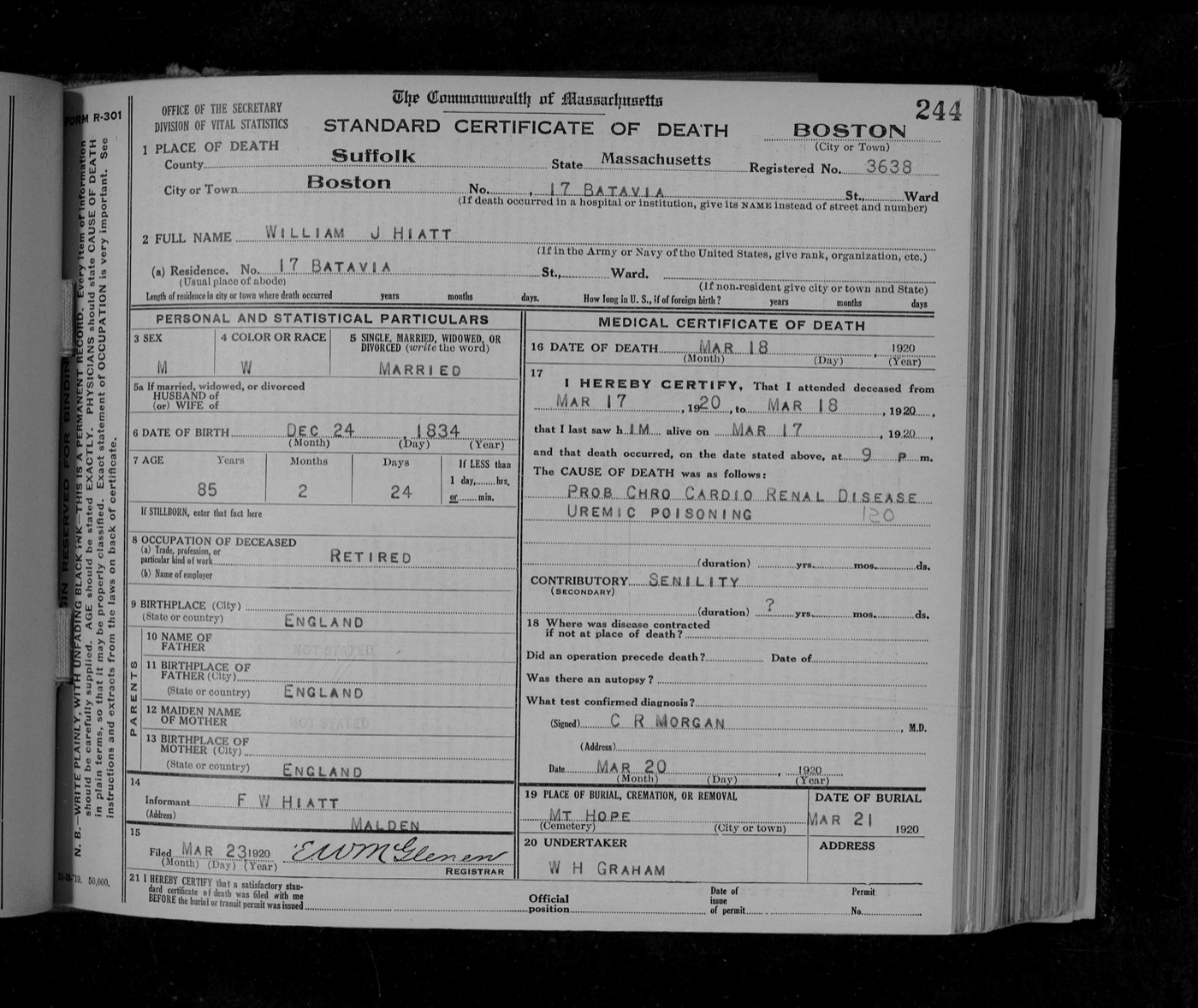
- His death record, 1920: born December 24, 1834, age 85 years, 2 months, 24 days
The heading of this page uses December 24, 1839, the date William swore to when he became a citizen. The two earliest records, though, the 1841 census and his marriage record, both point to about 1837, and the 1841 census was taken when he was a small child. Children's ages in that census were usually given exactly. His true birth year may be 1837. On the death record, his son Frederick gave the same day, December 24, but the year 1834. Frederick may not have known the year.
To Boston
William came to America on the steamship Niagara, which left Liverpool on April 23, 1859, and arrived at Boston on May 6, 1859. The passenger list names him Wm Hiatt. Years later, in his naturalization papers, he gave April 23, 1859, as the day he arrived, but that was the day his ship sailed from Liverpool. The 1910 census also gives 1859. He was about twenty when he came, already trained in his father's trade.
In 1862 William married Margaret Ann Taylor in Boston. She was born in Nova Scotia. Their son Frederick William was born in October 1863 in Somerville, just north of Boston. In 1870 the family was still living in Somerville, where the census taker wrote the name as Hyatt. A second son, Winfield W., was born on August 25, 1872, at 66 Appleton Street in Boston.
His Brother Richard
William's older brother, Richard T. Hiatt, had also come to Massachusetts. He was a watchmaker like his father and brother, and had worked for Mr. Bond, the chronometer maker, for nearly nine years, since about 1853. It may have been Richard who brought William into the Bond firm. Richard lived in Melrose with his wife and child. A few weeks before, they had lost another child, and his wife had gone to Maine with the child who was left, to get away for a while from the place where her child had died.
On Thursday night, November 20, 1862, a friend from work, the watchmaker Charles Galliers, stayed with Richard at Melrose, because Richard wanted company. Early the next morning the two men took the Reading train in to Boston on the Boston and Maine Railroad. They rode in the forward part of the first car, where men were allowed to smoke. The morning was rainy, and the fog grew thicker as they came near Boston. At about seven minutes before seven, the train reached the drawbridge over the channel between Charlestown and Boston. The draw was open. The drawtender had opened it for a vessel early that morning, lain down on a couple of chairs, and gone to sleep. In the fog the engineer did not see the signal in time. The engine and the first car went off the bridge into the water.
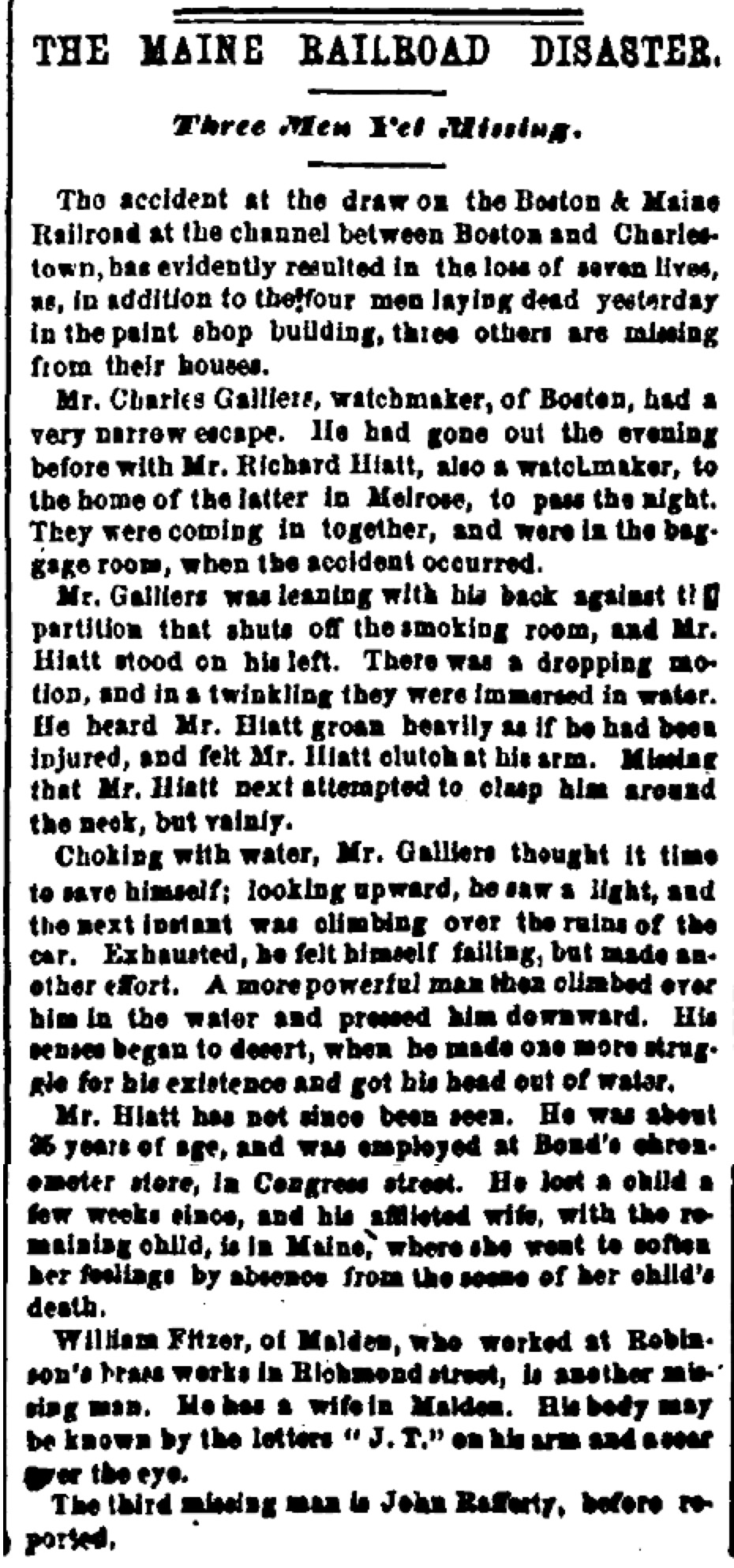
THE MAINE RAILROAD DISASTER. Three Men Yet Missing.
Mr. Charles Galliers, watchmaker, of Boston, had a very narrow escape. He had gone out the evening before with Mr. Richard Hiatt, also a watchmaker, to the home of the latter in Melrose, to pass the night. They were coming in together, and were in the baggage room, when the accident occurred.
Mr. Galliers was leaning with his back against the partition that shuts off the smoking room, and Mr. Hiatt stood on his left. There was a dropping motion, and in a twinkling they were immersed in water. He heard Mr. Hiatt groan heavily as if he had been injured, and felt Mr. Hiatt clutch at his arm. Missing that Mr. Hiatt next attempted to clasp him around the neck, but vainly.
Choking with water, Mr. Galliers thought it time to save himself; looking upward, he saw a light, and the next instant was climbing over the ruins of the car. …
Mr. Hiatt has not since been seen. He was about 35 years of age, and was employed at Bond's chronometer store, in Congress street. He lost a child a few weeks since, and his afflicted wife, with the remaining child, is in Maine, where she went to soften her feelings by absence from the scene of her child's death.
Richard's body was recovered on November 24 by a diver, F. L. Merriam, who went down in submarine armor to the bottom of the channel, forty feet under water. At the coroner's inquest Galliers said, "I have known Mr Hiatt three years, and he has a wife and one child, and has worked for Mr Bond nearly nine years, and lived in Melrose about six years." The jury found that Richard T. Hiatt "came to his death on the 21st of November, 1862, at about seven minutes before seven o'clock A.M., by drowning." They blamed the engineer for not stopping when the signals could not be seen, the drawtender for being asleep, and the railroad for not giving the drawtenders clear enough instructions. Seven men were believed to have died.
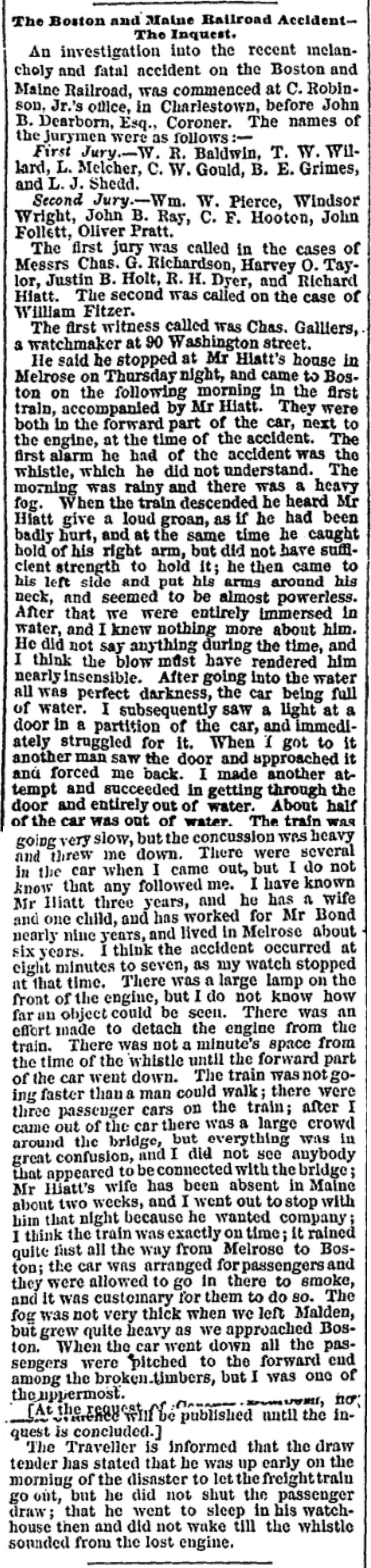
Richard was about 35. He is the Richard T. Hiatt, born in 1827, who is buried in Wyoming Cemetery in Melrose. William's son Frederick was later buried in the same cemetery.
Chronometer Maker
A marine chronometer was a very accurate clock carried on ships. By comparing the time at the ship's position with the chronometer's time at a known place, a navigator could work out how far east or west the ship had sailed. A chronometer that gained or lost even a few seconds a day could put a ship miles off course, so chronometers were cleaned, adjusted and rated by skilled makers between voyages. Boston was one of the busiest ports in the country, and there was steady work.
The Boston city directories list William J. Hiatt, chronometer maker, from 1880 to 1901:
- 1880: 97 Water Street; house 65 Appleton Street
- 1881: 97 Water Street; house Hotel Hudson
- 1883 and 1884: 97 Water Street; house 55 Chandler Street
- 1885 and 1886: 112 State Street; house 55 Chandler Street
- 1887 and 1888: 112 State Street
- 1890: 134 State Street, and confectionery at 1609 Washington Street; house Hotel Clifton
- 1892 and 1893: 134 State Street; house 455 Columbus Avenue, the Hotel Clifton
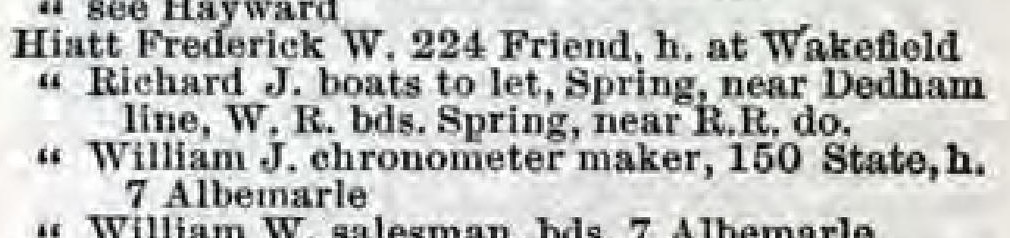
- 1894 to 1901: 150 State Street; house 7 Albemarle Street
Every one of those work addresses was also the address of William Bond & Son, chronometer and watch makers. Bond & Son was at 97 Water Street in 1884, at 112 State Street in 1885, at 134 State Street in 1890, and at 150 and 152 State Street from 1894 on. Each time the firm moved, William's address moved with it. The directories never say who William worked for, but he almost certainly worked for the Bonds for more than twenty years, as his brother Richard had before him.
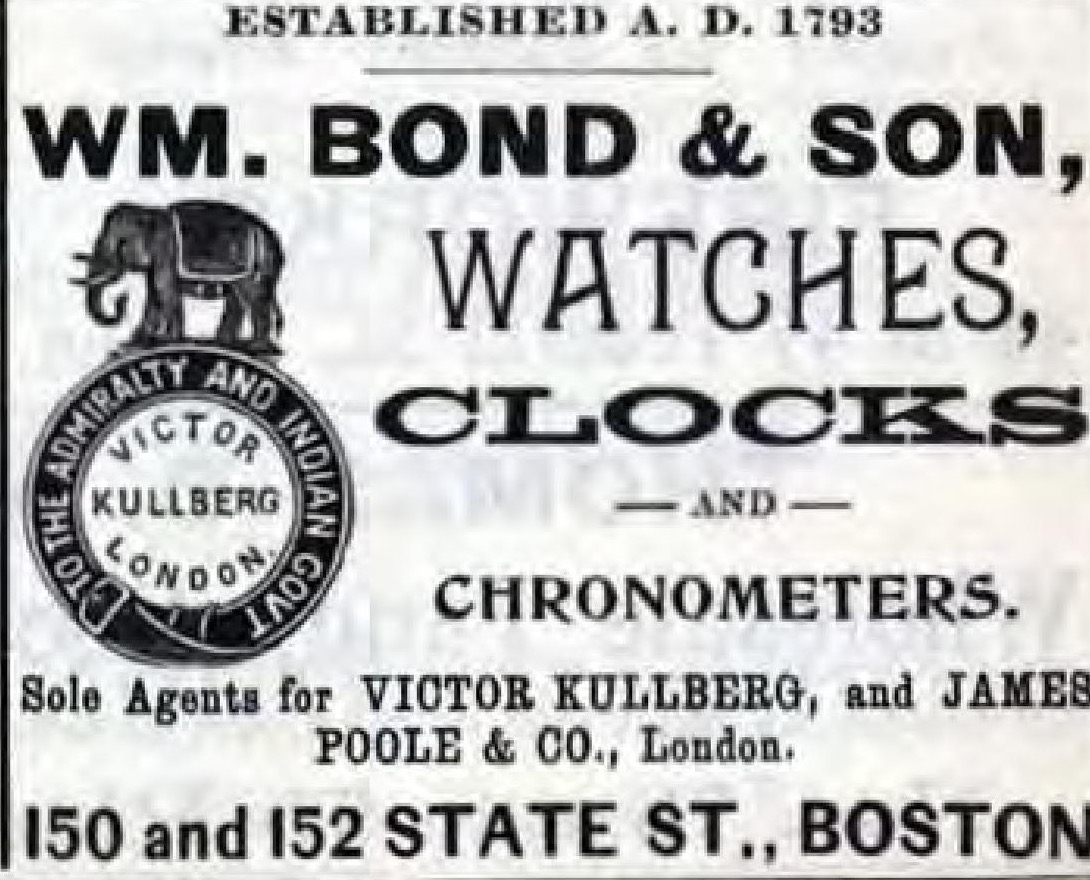
William Bond & Son was one of the oldest and best known firms of its kind in America. William Cranch Bond, the son in the firm's name, was a self-taught astronomer and clockmaker who became the first director of the Harvard College Observatory. The firm sold, repaired and rated chronometers for ships sailing out of Boston for well over a century.
The family lived in rooms, boarding houses and hotels in the South End, near Columbus Avenue. For a while Frederick lived with his father. From 1883 to 1886 both were at 55 Chandler Street, and in 1890, 1892 and 1893 both lived at the Hotel Clifton on Columbus Avenue.
The Candy Store, and Winfield
In 1888 William opened a second business. The business section of the 1888 directory lists W. J. Hiatt, 1609 Washington Street, among the confectionery dealers, and the 1890 directory lists him as chronometer maker and confectionery, 1609 Washington. It was his younger son, Winfield, who ran the candy store.
Winfield was a worry to his father. In August 1889, when he was seventeen, he was arrested for helping two other young men rob the Estes building on Summer Street and tie up the janitor, Thomas J. Paine. The Boston Globe told the story, and it gives a rare picture of William himself.


“Third Youth Implicated,” Boston Globe, August 30, 1889, page 5.
THIRD YOUTH IMPLICATED
In the Assault on Janitor Paine—A Revolver Taken from the Young Man's Father.
Robert Brown and Wade C. Cummings, the two young men yesterday arrested on the charge of having murderously assaulted Janitor Paine in the Estes building, Summer street, on Tuesday night, last night made a full confession to Sergt. Brickley of station 2. One of the boys had previously made a partial confession, and last night both made a clean breast of the matter and implicated another in their crime. Winfield W. Hiatt, 17 years of age, who lives at Hotel Clifton, Columbus avenue, and runs a candy store at 1609 Washington street, was the person who, Brown and Cummings claim, assisted them by holding old man Paine after they had felled him to the floor while they bound him with the cord. Sergt. Brickley found that the three had been more or less together, and this noon arrested young Hiatt on Washington street. On the boy's person was a considerable sum of money, and it is thought that knowing of the arrest of his two chums, he was making preparations to run away from the city.
When Sergt. Brickley went to inform the father of his son's arrest a most dramatic scene occurred. Hiatt on two other occasions, it is said, has got into trouble through appropriating money belonging to his employers, but the cases have been fixed, and the young man has been given every inducement by his father to lead a straightforward and honest life, but all the efforts of the father appear to be of no avail. Mr. Hiatt, Sr., is a little man of about 5 feet 2 inches and is highly respected by all who have his acquaintance. He was greatly agitated when informed of this latest charge against his son, and remarked that life was not worth living. Walking across the room, he took something out of a drawer and placed it in his pocket. As he walked back, Sergeant Brickley saw the ivory handle of a revolver in the pocket and attempted to take it away from him, fearing that in his present state of mind Mr. Hiatt might do himself injury. Although the sergeant is a large strong man, he had quite a wrestle with him before he succeeded in getting the revolver, one of 32-caliber and loaded. As Sergeant Brickley put the revolver in his pocket, Mr. Hiatt remarked, “Never mind, I can get another.” Young Hiatt is a very good dresser and his wayward acts much affect his father, whose liberality to his son should relieve the latter of all desire to gain money other than in an honest manner.
The grand jury indicted Winfield, Brown and Cummings for breaking, entering and larceny, and for assault on the janitor with intent to murder. Winfield pleaded guilty to the breaking, entering and larceny. On September 11, 1889, Judge Staples of the Superior Criminal Court sentenced him to four years in the house of correction, with one day in solitary confinement. The Globe added that "Hiatt was not concerned in the assault."
In October 1896 Winfield was in court again, charged with breaking into a house on Massachusetts Avenue and stealing jewelry. The judge found him not guilty. The Globe called him "Winfred W. Hiatt, alias William W. Hiatt." So the William W. Hiatt, salesman, who boarded with William at 7 Albemarle Street in 1897 was Winfield.
After that Winfield found his place on the stage. In 1899 he toured western Massachusetts with the company of the musical farce A Wild Goose Chase, and in 1905 he was with the Roe Stock Company, playing Sherlock Holmes. In both companies was the comedienne Nellie Franklin, and the two of them went on to work together as a vaudeville act, “Franklin and Hiatt.” In 1910 he bought a new three-apartment house at 33 Pleasant Park Road in Winthrop. He was still acting in Boston in 1926, when he played Stuyvesant Wood in The Girl from Childs with the Castle Square Players.
Winfield died at Boston City Hospital on May 20, 1932, of acute pericarditis, with hardening of the arteries and anemia. He never married. He was buried in Mount Hope Cemetery, where both his parents were buried.
Citizen
William first declared his intention to become a citizen before the Circuit Court of the United States in Boston on September 8, 1887. A stain covers part of the year, but it appears to be 1887. On July 30, 1892, he went back to the same court and was admitted as a citizen. His petition calls him William J. Hiatt of Boston, watchmaker, born in England on or about December 24, 1839, and now about fifty-one. It says he arrived at Boston on or about April 23, 1859, which was really the day his ship left Liverpool. His work address, 134 State Street, is written in the margin.
Two witnesses swore that they had known him for five years, while he lived in Boston and Somerville, and that he was a man of good moral character: John Ogden of South Boston and William Crowe of Tremont Street, Boston. William then took the oath renouncing his allegiance to Queen Victoria and signed his name.


Last Years
William was still listed as a chronometer maker at 150 State Street in 1901, when he was in his sixties. In the 1900 census he was living in Boston's Ward 10, and he was still there in 1910, at 71.
William died at home, 17 Batavia Street, Boston, at nine in the evening on March 18, 1920. The death record calls him married and retired. The doctor, C. R. Morgan, who had first attended him the day before, gave the cause as "prob. chro. cardio renal disease," that is, probably long-standing disease of the heart and kidneys, with uremic poisoning, the build-up of waste in the blood when the kidneys fail. Old age was a contributing cause. His son F. W. Hiatt of Malden gave the information for the record, but did not give the names of William's parents. William was buried in Mount Hope Cemetery in Boston on March 21, 1920. The undertaker was W. H. Graham.
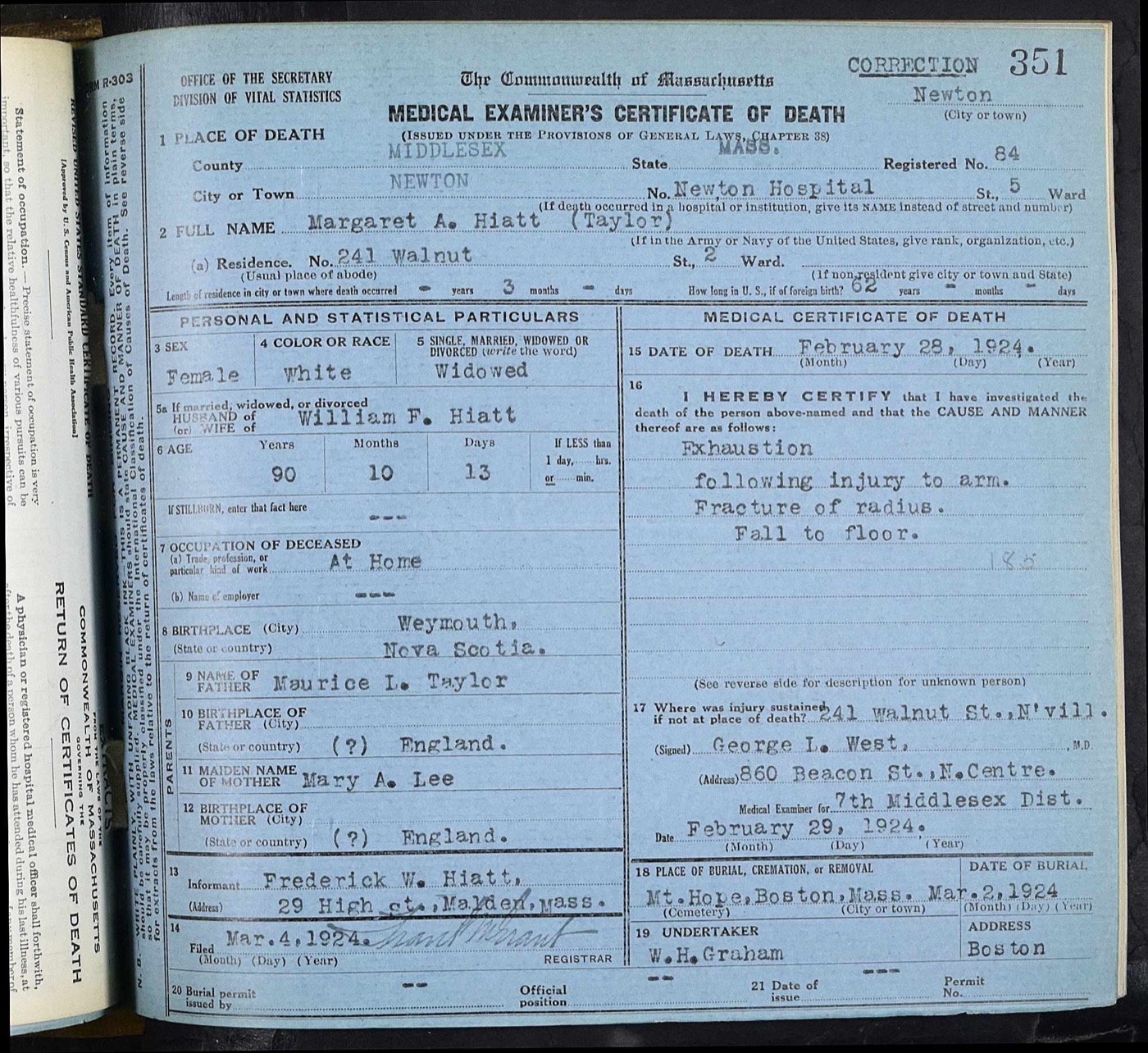
Margaret outlived William by four years. Her death record says she was born in Weymouth, Nova Scotia, the daughter of Maurice L. Taylor and Mary A. Lee, and that she had been in the United States for 62 years. In her last months she lived at 241 Walnut Street in Newtonville. There she fell to the floor and broke her arm, and she died of exhaustion following the injury at Newton Hospital on February 28, 1924. She was 90 years, 10 months and 13 days old. Her son Frederick gave the information for the record. She was buried with William in Mount Hope Cemetery on March 2, 1924.