Anne Lemaître was a widow in her forties when she left Dieppe for New France, where her only son, Nicolas Leroy, was raising a family. She married again at Quebec, with her son and daughter-in-law at her side.
Dieppe
Anne Lemaître, whose name was also written Le Maistre, was born about 1618 in the parish of Saint-Rémy in Dieppe, a port on the coast of Normandy in the archdiocese of Rouen. No baptism record has been found for her, and her parents are not known. The censuses of New France give her age three different ways, which point to a birth between 1617 and 1619.
On April 27, 1638, she married Louis Leroy at Saint-Rémy. About a year later she gave birth to their son Nicolas, who was baptized at Saint-Rémy on May 25, 1639. He is the only child of Louis and Anne who is known.
No record of Louis's death has been found. He was dead by the time Anne left France, and her marriage record of 1663 calls her the widow of “the late Louys Le Roy.”
To New France
Nicolas, his wife Jeanne Lelièvre and their two little boys sailed for New France in 1661. Family histories say that Anne, now a widow, went with them. By the fall of 1663 she was living in the town of Quebec.
Was Anne one of the King's Daughters?
Between 1663 and 1673 more than 800 women, the filles du roi or King's Daughters, were sent to New France at the expense of King Louis XIV to marry settlers. Because Anne married at Quebec in the fall of 1663, the year the first of them arrived, the historians Silvio Dumas and Yves Landry and the genealogist Peter Gagné included her on their lists. She was not one of them. She came to join her son's family, and when she married, it was Nicolas and Jeanne, not the king's officials, who stood with her.
A Second Marriage, 1663
On November 7, 1663, Anne married Adrien Blanquet at the church of Notre-Dame in Quebec. She was about 45, and he was about 58. Adrien was the son of André Blanquet and Perrette Caperon, of Auqueville near Dieppe, so the two came from the same corner of Normandy. The banns were read on October 28 and on November 1 and 4, and the marriage was performed by Henri de Bernières, the parish priest of Quebec.

Adrian Blanquet and Anne Le Maistre (translated from the French)
In the year of grace 1663, the 7th of November, after betrothal and the publication of three banns at the sermon on the 28th of October and the 1st and 4th of November, and no lawful impediment having been found, I, Henry de Bernières, parish priest of this parish, questioned Adrian Blanquet, son of André and of Perrette Caperon, of the parish of Auqueville near Dieppe, of the one part, and Anne Le Maistre, widow of the late Louys Le Roy, of the parish of Saint-Remy of Dieppe, of the other part, and having received their mutual consent, I solemnly joined them in marriage by words of the present, in the presence of the known witnesses Jacques La Rue, joiner, Guillaume David and others.
H. de Bernières
The Marriage Contract
Two weeks before the wedding, on Thursday, October 25, 1663, Anne and Adrien went to the office of Jean Gloria, royal notary at Quebec, to sign a marriage contract. A Jean Gloria of Dieppe had lent Nicolas the money for his family's passage in 1661, so Anne may have known the notary from home.
The contract calls Adrien an habitant, a settler, of the Île d’Orléans, and Anne the widow of the late Louis Le Roy of Dieppe, “at present living in this town of Quebec.” Adrien was assisted by Gabriel Gosselin, a settler of the same island, and by Claude Aubert, notary and clerk of the Côte and seigneury of Beaupré. Anne was assisted by her son Nicolas Le Roy and his wife Jeanne Lelièvre.
The terms followed the Custom of Paris, the law of New France. The couple would share their movable goods and the property they acquired after the wedding, and neither would be responsible for the other's earlier debts. Anne was promised a dower of 300 livres, or the customary dower if she preferred, which would support her if she became a widow again.
The contract was signed by Adrien, by Nicolas (“Nicollas le roy”), by Claude Aubert, and by the witnesses Martin de Saint-Aignan and Nicolas Gauvreau. Jeanne Lelièvre and Gabriel Gosselin could not sign and made their marks. Anne's name appears among the signatures in an unsteady hand, so she may have written it herself.
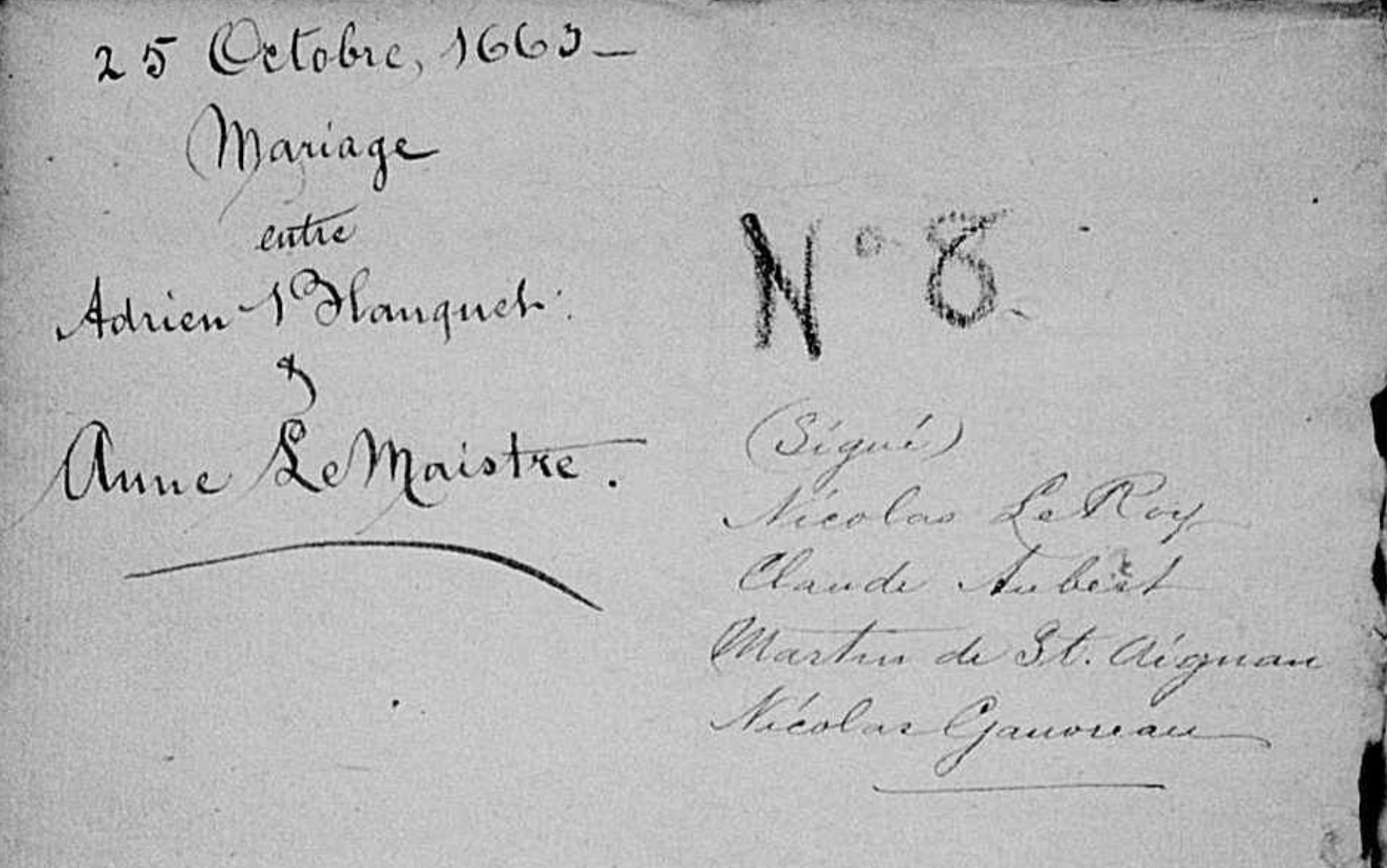
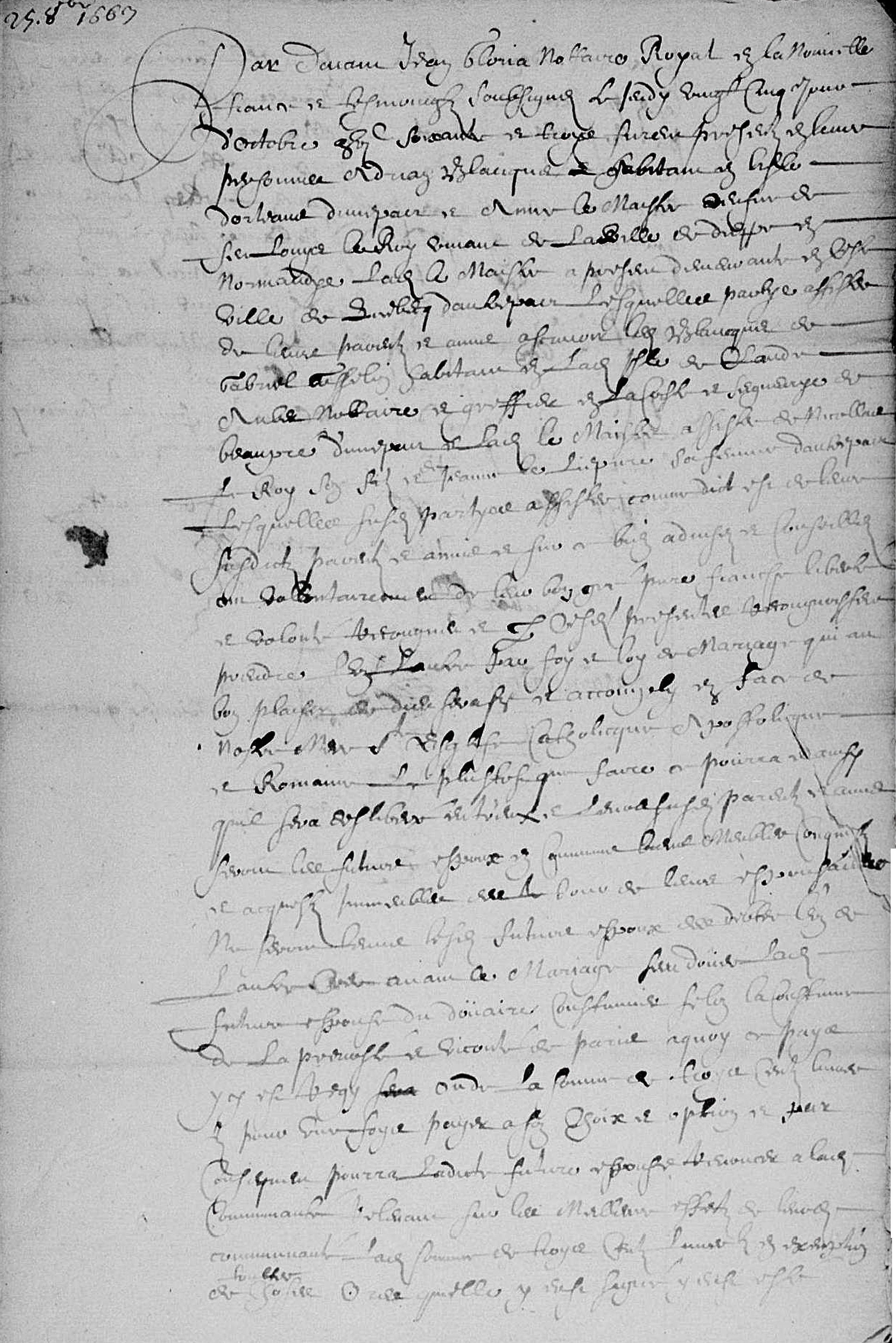
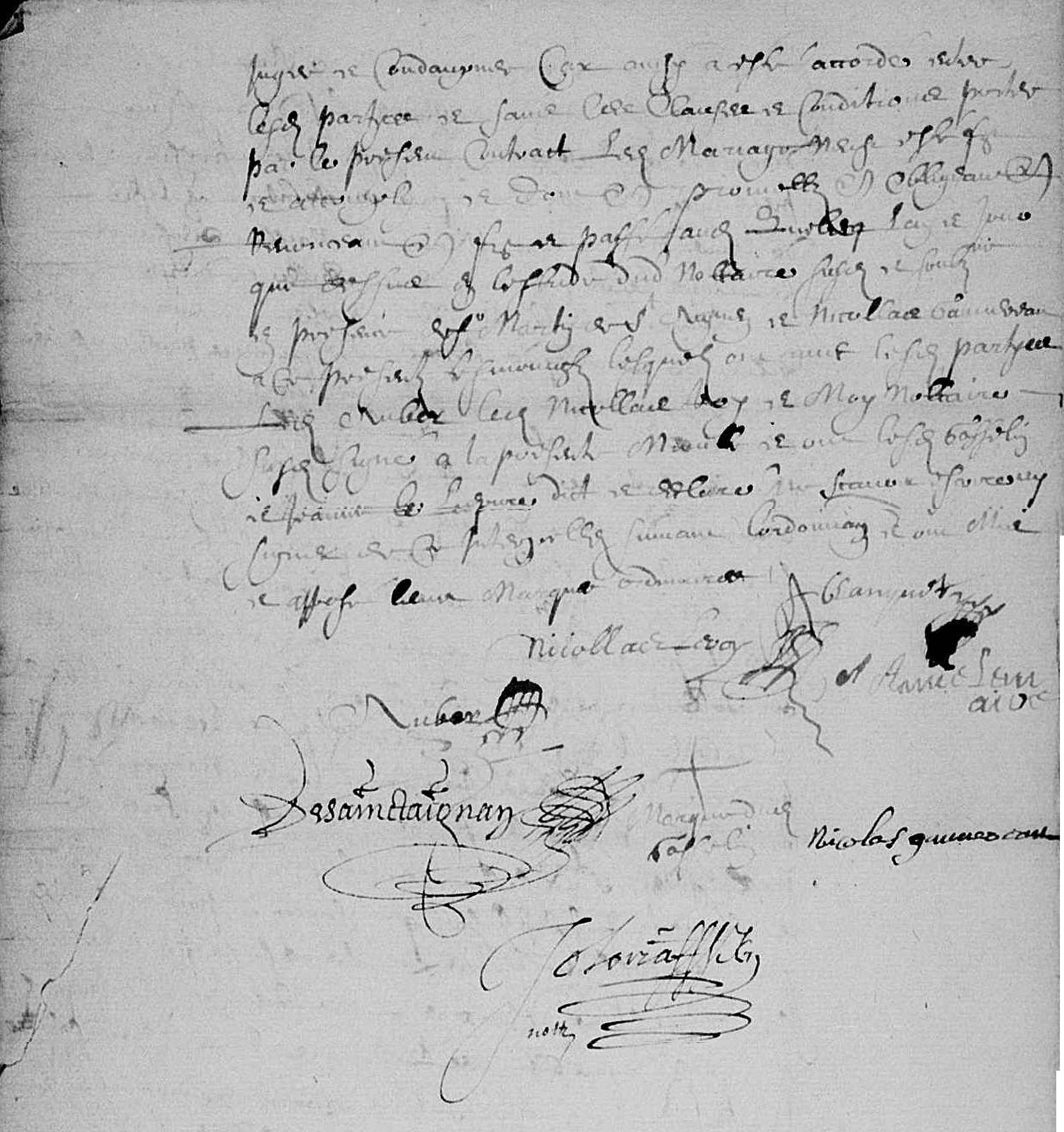
Marriage contract of Adrian Blanquet and Anne Le Maistre (translated from the French, in part)
Before me, Gloria, Royal Notary in New France, and the undersigned witnesses, on Thursday the twenty-fifth day of October, one thousand six hundred sixty-three, were present in person Adrian Blanquet, habitant of the Isle of Orléans, of the one part, and Anne Le Maistre, widow of the late Louys Le Roy, in his lifetime of the town of Dieppe in Normandy, the said Le Maistre at present living in this town of Quebec, of the other part.
Which parties, assisted by their relatives and friends, namely the said Blanquet by Gabriel Gosselin, habitant of the said isle, and by Claude Aubert, notary and clerk of the Côte and seigneury of Beaupré, of the one part, and the said Le Maistre assisted by Nicollas Le Roy her son and Jeanne Le Lievre his wife, of the other part … have promised to take one another by faith and law of marriage, which shall be celebrated before our Mother the Holy Catholic, Apostolic and Roman Church as soon as may be done …
The future spouses shall be in community of all movable goods and acquired immovables from the day of their wedding. They shall not be held for the debts of one another made before the said marriage. The future bride shall be endowed with the customary dower according to the Custom of the Prevostship and Viscounty of Paris, or a fixed dower of the sum of three hundred livres, paid once, at her choice …
Done and passed at the said Quebec, the year and day above, in the office of the said Notary, in the presence of the Sieurs Martin de St Aignan and Nicolas Gauvreau, witnesses …
[Signed] A Blanquet, Anne Lemaitre, Nicollas le roy, Aubert, de sainct aignan, Nicolas Gauvreau; mark of Gabriel Gosselin; Gloria, notary
Anne and Adrien had no children. She was past the age for it, and her family in the colony was her son's.
Her Later Years
Anne appears in the censuses of 1666, 1667 and 1681. No death or burial record has been found for her or for Adrien Blanquet. If she lived past 1688, she outlived her son Nicolas, who died between 1686 and 1688.
The family trees say that she was buried on October 1, 1718, at Saint-Pierre on the Île d’Orléans, at the age of 100. But the entry they rely on notes that the date of her death is unknown and that this was a transfer to the new church, so October 1, 1718, is when her remains were moved, not when she died.
Did she live to 100?
Her dates are often given as 1618–1718, and many family trees repeat them. The 1718 entry at Saint-Pierre appears to record the moving of remains to the new church rather than a burial at the time of death, so she may have died years earlier. The last record found of her alive is the census of 1681. Her death and burial record has not been found.
A Video about Anne
This YouTube video tells the story of Anne's life.