Sarah Timmins married Henry Harper and went with him to Wakefield, Massachusetts, where they raised ten children, among them Elizabeth Harper, the mother of Edith Hiatt. This page is about the family Sarah left behind in the Black Country of Staffordshire.
Timmins is the name on Sarah's birth record. The name was also written Timmons, Timmings and Timmens, and in America Sarah was usually Sarah Timmons.
William Taylor and Jemima Law
Sarah's mother, Elizabeth Taylor, was the daughter of William Taylor and Jemima Law. William was born about 1774 and Jemima about 1777, both in Staffordshire. They were married on November 6, 1797, at St. Peter's Collegiate Church in Wolverhampton. Elizabeth was born about 1803 in Sedgley. Baptisms of other children of a William Taylor were recorded at St. James, Newchapel, in Staffordshire: Sarah in 1811, Lucy in 1813 and Samuel in 1814. Samuel was buried there in April 1832. An Emma Taylor, daughter of a William Taylor, was baptized in 1821.
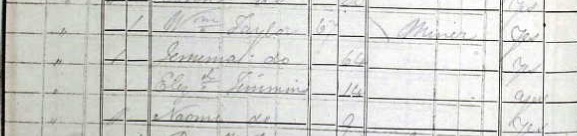
In the 1841 census William Taylor, 67, a miner, and his wife Jemima, 64, were living on Mount Pleasant in Sedgley. With them were two of their granddaughters, the two oldest children of Benjamin and Elizabeth Timmins: Elizabeth, 14, and Naomi, 9.
William Taylor probably died on November 30, 1850, at Tipton, the next parish. The death record says he was 76 years old, a labourer, and that he drowned. The cause was "Drowning, Accidental, Instant death," and the information came from the coroner, Thomas Moss Phillips of Wolverhampton.

Five weeks later, on January 5, 1851, Jemima died at Mount Pleasant, Deepfields, in Coseley, where she had been living in 1841. She was 75. The death record calls her the "Widow of William Taylor, Miner," and gives the cause as diarrhoea and debility. Her granddaughter Naomi Timmins was with her when she died, and signed the register with her mark.

Cholera came to the Black Country several times between 1832 and the early 1850s, and diarrhoea was one of its signs. Jemima's record does not say cholera, so it is only a possibility.
Is this the right William Taylor?
English death records of 1850 do not name a wife or parents, so this record cannot be tied to Sarah's grandfather directly. The evidence is indirect. The age of 76 fits the William Taylor who was 67 in 1841. Tipton is next to Coseley, where Jemima died. And Jemima's own record, five weeks later, shows that her husband William Taylor had died by then. The record is probably his, but not certainly. He was called a miner in 1841, a coke-maker on his daughter's marriage record of 1855, and a labourer on this death record, which is not unusual for a man who worked around the coal pits.
Benjamin and Elizabeth Timmins
Sarah's father, Benjamin Timmins, was born about 1806 in Staffordshire. He and Elizabeth Taylor were married at Sedgley on December 4, 1825. Their children were:
- Elizabeth, born about 1827
- Naomi, called Nennie, born about 1832 at Hall Green
- Thomas, baptized January 28, 1835, who died on November 4, 1835
- Jacob, born about 1839
- Sarah, born April 25, 1841, at Sedgley
The 1841 census was taken on the night of June 6. It found Benjamin, 35, a forgeman, living on Dark Lane in Sedgley with Elizabeth, 30, their son Jacob, 2, and a baby girl six weeks old, not yet named. The baby was Sarah. Her birth record gives her birth date as April 25, 1841, exactly six weeks before the census. Ages of adults in the 1841 census were usually rounded down to the nearest five years, so Benjamin and Elizabeth may have been a few years older than the census says.
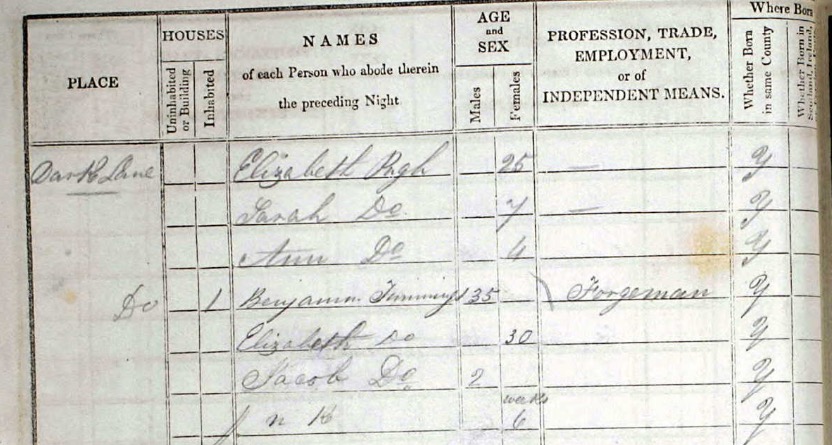
A forgeman worked at a forge, heating iron and hammering it into shape. The Timmins and Taylor families lived in the Black Country, the district around Wolverhampton, Dudley, Bilston and Tipton. It got its name from the coal seams that lay so close to the surface that the soil looked black, and from the smoke of the coal pits, furnaces and ironworks that blackened the air. Nearly every man in the family worked in coal or iron.
A Widow in Bilston
Benjamin had died by 1851. When or where has not been found. In the 1851 census Elizabeth Timmings, a widow, was living in Bilston, in the parish of St. Mary, with Naomi, called "Nennie," 19, and Jacob. Elizabeth and Nennie were laundresses, and Jacob was a labourer at the iron works.

Sarah was nine in 1851 and was not living with her mother. She may be the Sarah who was living with John Lowe and his wife as a relative, or the Sarah who was a servant in the household of Joseph Beyan. Which, if either, is her is not certain. Her oldest sister, Elizabeth, is not with the family either. She may have married. She was probably still living in 1892, when Sarah's obituary said she had a brother and two sisters in England.
Two Marriages in Bilston
On May 8, 1853, Naomi married George Humphreys, a blacksmith, at St. Leonard's Church in Bilston. Their son, Jacob Humphreys, was baptized in Bilston on October 23, 1857. In 1861 George Humphries and his family were living in Tipton.
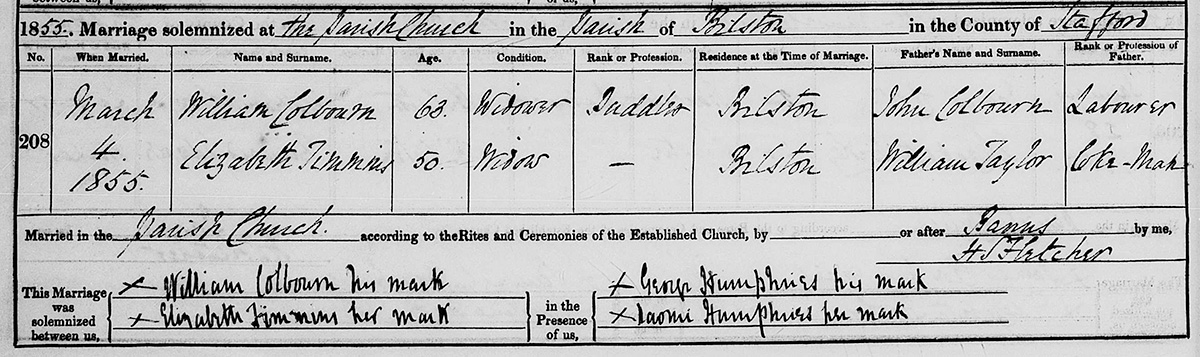
Two years after Naomi's wedding her mother married again. On March 4, 1855, at the parish church of Bilston, Elizabeth Timmins, a widow of 50, married William Colbourn, a widower of 63 and a puddler. The record names her father as William Taylor, coke-maker, and his as John Colbourn, labourer. Neither the bride nor the groom could write, and they signed with their marks. So did the witnesses, Naomi and her husband George Humphries.
In the 1861 census Jacob and Sarah were living with their mother and stepfather at 5 Pearson's Yard, Bilston, in the parish of St. Mary. William Colbourn, 73, born at Minworth in Warwickshire, was a labourer in the iron works. Elizabeth, 58, was a domestic. Jacob Timmings, 21, was an iron puddler, and Sarah, 19, was a domestic servant. A puddler stirred melted pig iron in a coal-fired furnace to turn it into wrought iron. It was hot, heavy, skilled work.

Sarah Goes to America
Sarah married Henry Harper. A letter written about the Harper family reunion of 1986 and Sarah's own obituary both say they were married in Staffordshire on October 10, 1863. A family history gives December 24, 1864, at Dudleyport. No record of either marriage has been found in England.
In 1865 Henry and Sarah sailed for Quebec and went on to Oswego, New York, where their first child, Harry, was born in 1865. They went back to England in 1866 and lived in the Birmingham area, where Jessie, Arthur and Alice were born. In 1870 Henry went to Boston alone. The 1871 census found Sarah with the four children in Wolverhampton, not far from her own family. That fall she and the children sailed from Liverpool on the Calabria, arriving in Boston on October 2, 1871. She never came back.
The family settled in Wakefield, Massachusetts, where six more children were born. On July 8, 1886, after all ten children were born, Henry and Sarah were married in Boston. The record gives Sarah's maiden name, Timmins, names her parents as Benjamin and Elizabeth, and says it was the first marriage for both of them.
Sarah died at home on Nahant Street, Wakefield, on January 15, 1892. Her obituary said that in England "she became quite well known as a singer in churches of different denominations," and that "one brother and two sisters who live in Warrington, England, survive the deceased." You can read the whole obituary on Henry Harper's page.
Jacob, the Iron Puddler
Sarah's brother Jacob married Mary Edwards on December 7, 1863, at St. Bartholomew's, Wednesbury. Their daughter Elizabeth was baptized at Darlaston on April 10, 1864, and a second daughter, Mary, was born about 1868. Jacob followed the iron trade north. In 1871 he and his family were in Govan, Glasgow, Scotland, and he was still an iron puddler.
Mary died some time after 1871. On March 10, 1876, at St. James the Great in Latchford, Jacob married Elizabeth Hadwins, a widow born about 1848, whose father was John Peers. Jacob raised her two children, and they had five more, all born in Warrington, Lancashire: Jessie, Benjamin, Mary E., Carrie and Lily. The family was in Warrington in the 1881 and 1891 censuses, and Jacob was still puddling iron.
Warrington is where Sarah's obituary placed her brother and two sisters in 1892. Jacob was there, and it seems likely that Naomi and Elizabeth had moved there too, but they have not yet been found in Warrington.
The Dudley Union Workhouse
In the 1871 census William Colbourn, 83, was a watchman at the iron works, living in Tipton, in the parish of St. Mark, with Elizabeth, 68.
Not long after, the old couple went into the Dudley Union Workhouse. The Poor Law Amendment Act of 1834 grouped parishes into larger units called unions. To save money, the unions cut back on "outdoor relief," help given to the poor in their own homes. To get relief, a person had to enter the workhouse, where inmates lived, worked and were fed. The Dudley workhouse opened in 1859 on Burton Road, Dudley. It is no longer standing. At Dudley, married couples over 60 were allowed to live in the same ward. Younger couples were separated, and their children were placed in another ward.
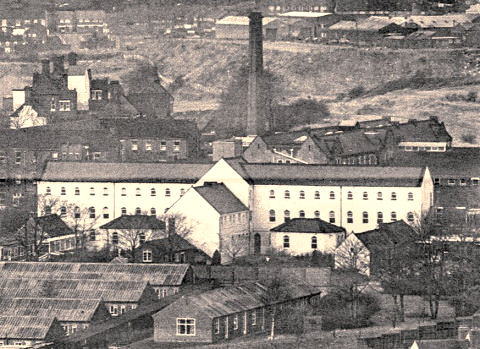
Elizabeth Colbourn died in the Union House on June 13, 1875. The record gives her age as 74 and the cause as "senectus, exhaustion," that is, old age. The informant was John Munn, another inmate, who signed with his mark. William Colbourn died in the Union House the next year, in May 1876, at about 84.

How old was Elizabeth?
Elizabeth's age is given differently in almost every record. She was 30 in the 1841 census, which rounded ages down. She was 50 when she married in 1855, which points to about 1805. She was 58 in 1861 and 68 in 1871, which both point to about 1803. Her death record says 74 in 1875, which points to about 1801. The two censuses agree, so about 1803 is used here. The death record's age was given by a fellow inmate of the workhouse, who may not have known.